Uji Gyokuro, Classic Representation of Japanese Green Tea
production
Gyokuro’s typical savoury taste character and exceptionally green colour, which are induced concentrations of amino acids and chlorophyll respectively, are very much dependent on horticulture.
gyokuro: turning a disadvantage to an advantage
In addition to the much known technique of shaded growth 3 weeks prior to plucking, the key to these concentrations are also the results of soil fertilization and the characters of the cultivars employed.
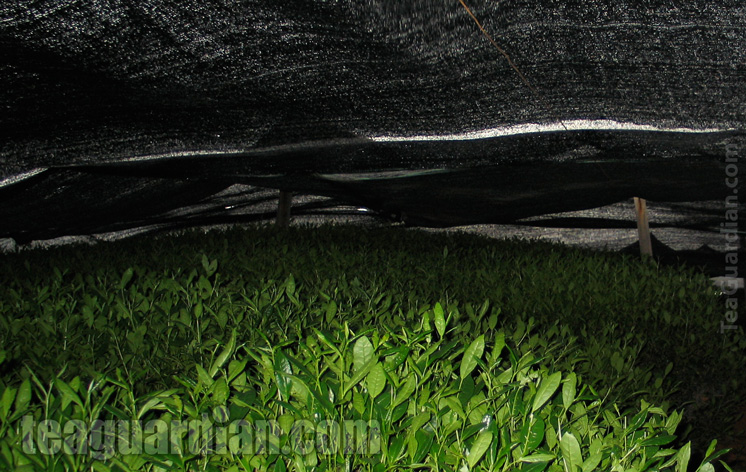
Ooishita: Shaded Growth in Gyokuro Production
While traditionally in China the finest teas are grown in rocky steppes of sandy soil, the relatively new volcanic soil of most of Japan is fertile in comparison. The gentle landscape does not allow much opportunity for shading away from the sun either. This was a blessing when export volume was needed in the 19th century. However, fast grown leaves yield low taste and much bitterness. Special cultivars are needed for slow growth for taste for a special quality tea such as gyokuro.
In the beginning, there was Yabukita, now Asahi, Okumidori, Yamakai and Saemidori have been added to the list. These are also the five main staple cultivars for most green tea farms in Japan now. These trees can take in more nutrients while maintaining a smaller leaf size and very soft leaf body, allowing for rolling into the thin needles that we recognize as this tea today.
shaded growth: manipulating nature
However, to do the trick of super-concentrating amino acids, which are building blocks for proteins and a key group of substances conducive to savoury taste, and chlorophyll, which is the exceptional green colour, “o-oi-shi-ta” has to be called in.
Ooishita, literally “under a cover”, basically a step to halt the growth of the young leaves by blocking the sun, imitating (and amplifying) the growing environment of fine teas in the steppes, when the high altitudes naturally restrict the duration of daily sunlight. On the sudden slow down of growth in the case of ooishita in gyokuro, nutrients from the fertilized soil continues to supply to the young leaves, thereby giving the smaller leaves a lot more amino acids, the materials originally intended for the leaves to grow big, and forcing them to manufacture more chlorophyll, the material needed to produce the energy for the growth that fails to materialize because of the suddenly reduced light.
Bamboo, wood or metal frameworks are constructed around the tea bushes and when it is determined that the on-coming pluck would be for producing gyokuro, the farmers cover the frameworks with bamboo meshes and then an additional layer of loose straw on top, to ensure an almost total block out of the sun for the tea bushes. The result is rather like a farm green house covered with thick layers of straw instead of plastic. With the exception of a few smaller farms, straw and bamboo have been replaced with black nylon fabric in recent years.
sencha, kabuse-cha, and gyokuro
In much of the 19th century, the process was pretty much all hand work, thereby maintaining the integrity of the whole-leaf. Since automation took over, the leaves can hardly stay whole, even though a lot of the productions are still hand-plucked; the extent of leaf manipulation in shaping the leaves has not been forgiving to the fragile tissues of what originally are very delicate leaves. However, the advancement in fertilizers and packaging technology that accompanied modernization has somehow given us a tea that is greener and fresher than ever.
Another popular Japanese green tea variety, kabuse-cha, or covered-grown tea, which is made almost entirely with the same procedure, using the same cultivars, is different from gyokuro with lesser fertilizer, lesser covered duration (usually only 2 weeks instead of 3), and less fine-tuning during processing, in particular the rolling step. Some farms do not even build a framework for the cover.