Tieguanyin, the Quintessential Minnan Oolong

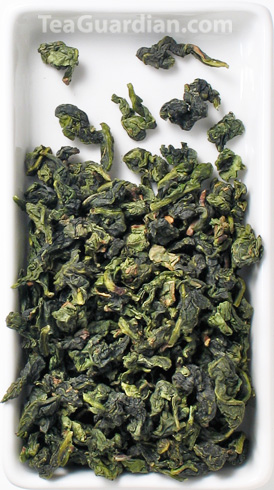
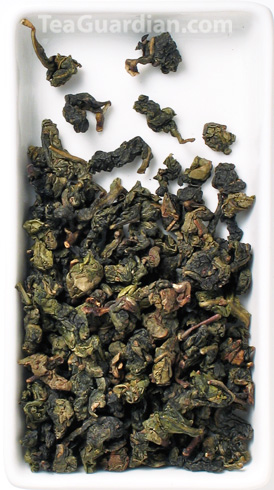
Tieguanyin, Floral Style. 清香型鐵觀音 This most famous of all Minnan oolongs 閩南烏龍. It can come in many styles, differing in depth of oxidation, greenness, and levels of baking. This is a higher quality with standard oxidation and green finish
20561 | 8865
tiě•guān•yīn 鐵觀音
origin: Anxi and vicinity in southern Fujian (Minnan)
Tieguanyin, formally should be spelled as Tie’guanyin, aka Te Guan Yin, or Teguanyin, Iron Goddess of Mercy, Tit Koon Yum, Guanyin etc is the most known oolong from the Minnan area. There are two popular finishes — bouquet and browned. For the bouquet style, there are two popular harvests: Spring and Autumn. The former is adored for the fullness of the body and silkiness of the texture, the latter, its high bouquet aroma.
As for the browned style, there are various degrees of browning with huge differences in quality and skills. Good ones are extremely rare, although there are signs that this traditional style is making a gradual come back. This article is about the bouquet style; click <here> to read about the browned style.
origin
All sorts of fables exist for the origin of this tea and there is also the famous one of “Monkey-Picks”. We shall skip them here. If you are interested, please go to the Minnan oolong chapter for a non-fairy-laden account of how the tea has come about.
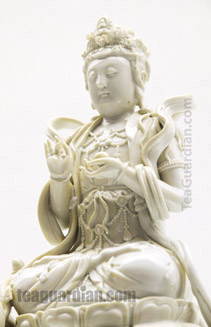
Guanyin, aka Guanshiyin, the goddess whose name is borrowed for that of the tea. » more
It is generally believed that the first tieguanyin appeared in mid-1700’s near a “Guanyin (note)” Rock in Anxi County in southern Fujian (Minnan). Today, fine genuine Minnan productions can be from Xianghua, for the best regards for aroma, those from Gande (găn-dé) for complexity in taste, those from Nanyan (nán-yán) for the pride of being the original ancestry. Because of the popular name, production has spread to many other regions to as far as Vietnam and Thailand, but most are only of mass market quality, with perhaps the exception of some from Mucha in Taiwan.
The original Tieguanyin cultivar has a reddish leaf-stalk. This feature was once used as a marker for authentic products. However, with spreading of the cultivation and decades of hybrids, this is no longer a reliable clue. However, the name Hong Xin Tiĕ (literally Tieguanyin with a red center) remains a certain prestige for older connoisseurs.
While Phoenix and Wuyi oolongs are prized for productions from matured bushes, Tieguanyins made from very young bushes have the best aroma. Very often in smaller high quality gardens, most bushes are never older than a few years. Plucking these small knee-high bushes is back-breaking.
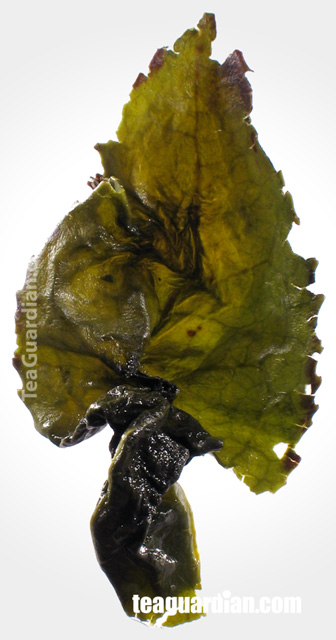
The infused leaves of a properly made Tieguanyin (enlarged) Notice that the edges of the leaf is broken. The reddened edges of the leaves of the Tieguanyin cultivars taste very bitter and are taken by a unique step in the production process: beating. The resultant leaves have this typical broken edge look, but most are usually stalk in, i.e. linked with one or two other leaves sharing the same stalk. This one is taken out to enlarge to show the difference.
tasting notes
Although a good balance of taste and aroma is obtainable using standard infusion parameters, the best way to enjoy a fine bouquet Tieguanyin is to put in a few times the tealeaves for a shorter infusion. A really fine one would give you a round, intense aroma with a velvety liquor of tinkling sensation. For a 150 ml taster’s mug or, better yet, a 140 ml gaiwan, begin experimenting with 8 g of tea with 95°C water for one to one and a half minutes. You can try your way up to 12 g, but the selection has to be really fine in order for this tea to water ratio to work.
A traditional thoroughly browned Tieguanyin, on the other hand, can be quite hardened by the firing and needs a lot of time to open up for a full body. Some people would blanch the tea an additional time instead, while others would smash a few kernels and bury the debris amongst whole kernels for quicker, but not over, release of taste.
health notes
In addition to theanine and flavonoids, Tieguanyin is rich in caffeine and essential oils so it is a good choice for relaxing while staying alert, during meditation and in times of stress.
The bouquet (green) style is cold in TCM term and should be drunk hot only to dissipate body heat and toxins. Infuse at ample strength and drink moderate amount. The best way for the body to intake the tea is a bit at a time. Please refer to gongfu infusion and enjoyment style. Drunk cold, the effects will be blocked by the cause of dampness. People with a weak stomach, weak physique, and those before and during menstruation, pregnancy, and recuperation should avoid this tea.
This cold TCM nature is moderated by fire in the browned style. Those selections that are well-browned are therefore suitable for most people. The tea has to be waited out of the excess heat at least 3 months after browning. It is, however, not as effective a detoxifying and relaxing agent as the bouquet style, but rather a digestive and a stimulant. Maturing a properly browned one for over 3 years is a popular practice for many connoisseurs. Tea sold as matured ones always fetch a much higher ticket than comparable new selections.
-

- Tieguanyin, Floral Style. 清香型鐵觀音 This most famous of all Minnan oolongs 閩南烏龍. It can come in many styles, differing in depth of oxidation, greenness, and levels of baking. This is a higher quality with standard oxidation and green finish 20561 | 8865
-
- Tieguanyin, 鐵觀音, the most famous of all Minnan oolongs. This is a floral style of medium quality and very green finish 20539 | 8819
-
- Tieguanyin, Medium Baked. 中火鐵觀音 The famous Minnan oolong baked to a medium degree 20315 | 8884
-
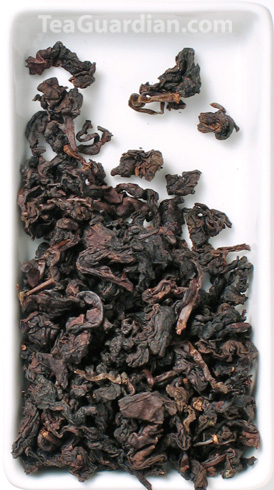
- Charcoal style Tieguanyin 碳焙鐵觀音, Minnan oolong 閩南烏龍 20598 | 8874
-
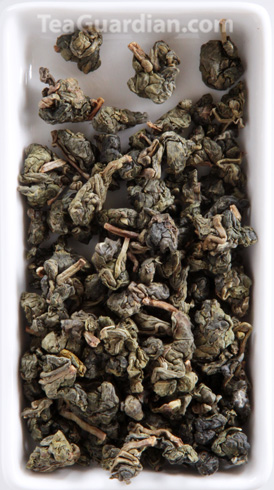
- An oolong from Vietnam
-
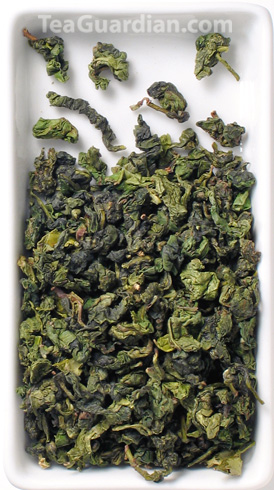
- Huangjin Gui, 黃金桂, a Minnan oolong 閩南烏龍, is often sold in green and floral finish for its floral aroma. This is a high quality. 20538 | 8811
-
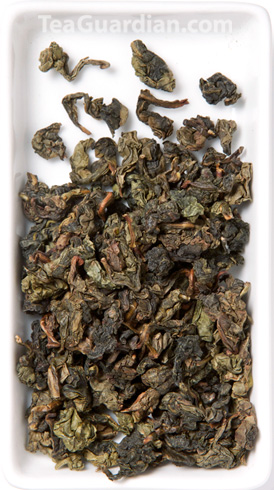
- Maoxie 毛蟹, aka Hairy Crab, a Minnan oolong 閩南烏龍. This is a baked version, unlike most greener styles more popular in the market today.
-
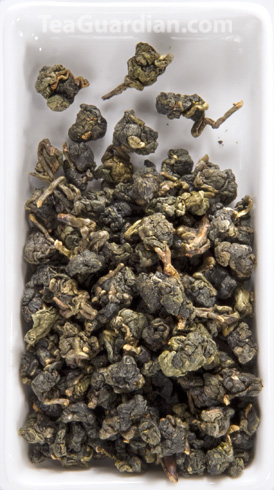
- Dongding oolong 凍頂烏龍, baked to the classical Taiwan traditional style. 21348
buying tips
Since Tieguanyin is by far the most sought after variety of oolong and the very fine ones do fetch a high price, it is a usual practice in the market to use other varieties in place of, or to blend in, the genuine products. One way to find out if your merchant is honest enough is to examine the infused leaves, when you know what you should be looking for. (more in later articles) Otherwise, buy from an honest and knowledgeable supplier.
There are also quite a range of quality depending on origin, horticulture, production mastery, and production seasons. Please be very aware of the fact that both poor and fine quality can be coming from a same origin, say, the popular Xianghua or Gande, or from a same cultivar, say Hong Xin or Qing Xin. There are always better ones and the exceptionally sensational. The price will be reflected, but sometimes out-of-proportionally so. There are always cheating retailers, or ignorant ones.
Another thing to look for is the storage condition of your supplier. Bouquet style ones do not keep well under room temperature, even if they are so-called “vacuum packed”. Refrigeration or a chill room is important in prolonging the shelf life of the aroma. Tasting is important in concluding a supply. <read about Anxi oolong storage><read about tea storage in general>
Finer spring harvests take place in April/May and autumn ones in October. These are the only two harvests you should buy. Dependent on how far or indirect your shop is from the source, you should be getting them one to two months afterwards. However, you have to be aware of the fact that this tea is harvested all year round so there could be August harvests sold in October, or that from November in April. Avoid those. Summer ones always taste more harshly and, more importantly, quite often exceed requirements of the upper limits of pesticide residues.
Since the browned version stores much better and is a much friendlier tea for all ages and body type, it is destined to be trendy again soon. A properly browned selection should not be made immediately after the harvest. The “green” nature of the tea has to be mellow out before it can be properly and thoroughly browned. Therefore, a spring selection should be browned in October the earliest and waited out to be consumed the next Fall. Producers do blend various selections to brown for cost saving. A good fire master knows what to put through the bake for maximum quality. The final taste quality reflects that. A poorly browned selection, no matter how dark the colour looks, would have the unwanted green taste popping out a few months after browning. It is wise not to rush to buy a newly browned tea. I shall write more about this in later articles.