Dinggu Dafang, Oldest Flat-style Green Tea
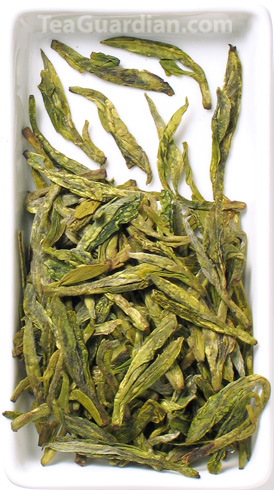
Dinggu Dafang: Possibly the first flat-style wok-roasted green tea
dĭng•gŭ dà•fāng 頂谷大方
other names: Ding Gu Da Fang, Laozhu Dafang, Dafang Cha, Huangshan Longjing
origin: Huangshan, Anhui
orientation
Dinggu Dafang may look like just another imitation Longjing, but this is deceptive of a much undervalued different taste character. It has an arguably longer history than Longjing; and may very well be some of the Songlo (aka Suonglo, Singlo, Songluo) varieties first exported to Europe in the 17th century.
The dry leaves have a darker, browner colour than other similar wok roasted flat green teas, because of a long tradition of using higher firing temperature in the region. It has a warm, malty aroma with a distinctive floral note; full, savoury body accentuated with just enough astringency.
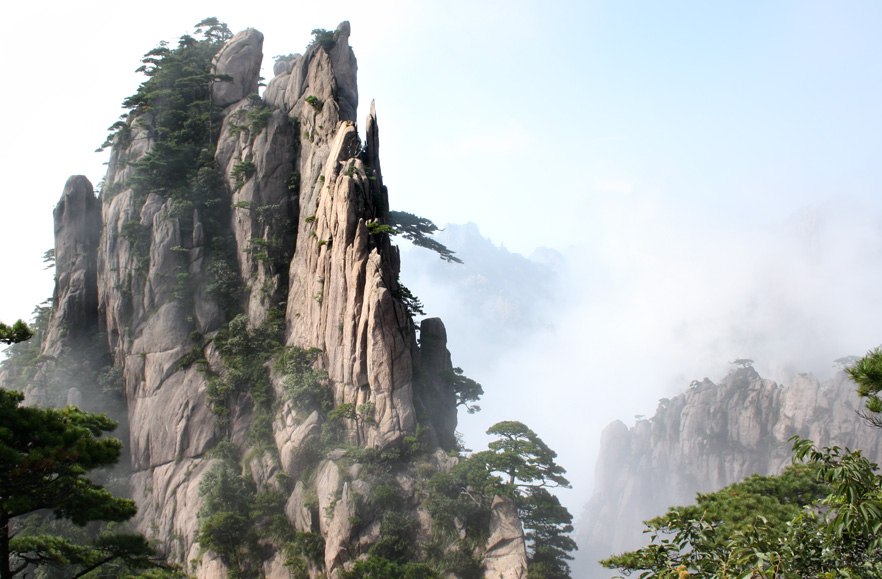
A scene in Huangshan, photo by Arne Hückelheim
origin
Huangshan (literally translated as Yellow Mountains) is one of the most scenic, mystic and adored mountains in China for millennia. South of the Yangtze River and west to the provinces of the prosperous East Coast, it maintains much of the natural lushness and the misty steep apexes that had impressed mandarins, scholars and monks when tea was first made there.
A monk by the name of Dafang roasted tea in Mount Lao Zhu (in Huangshan) in the 14th century by pressing a local first flush flat against the wok. Temperature not only cured the downy buds but also turned the green colour into yellow and some of the leaves slightly brown. Visitors to his temple, having traveled quite a distance, were served with this tea. His tea soon got more famous than his temple.
Lao Zhu Da-fang is still being made today, in a much wider area. Finer ones are still done manually, with the bare hand pressing the leaves against the wok, not unlike the way they still do it in Zhejiang with Longjing tea. Top quality productions, now called Ding-gu (top valley) Da-fang, have always been done this way not only for achieving the flat look typical of this yellow looking green tea, but also for the taste that would otherwise be inadequate in automated productions.
-

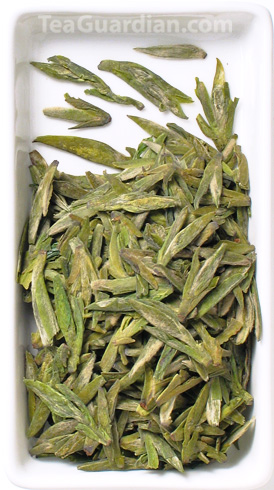
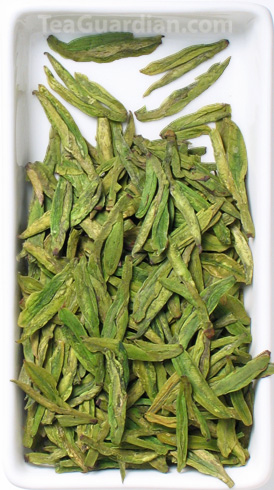
- Dinggu Dafang: Very often local producers refer to this tea as Longjing, because most customers do not know its real name. A Dafang is much more yellowish brown than most other flat-roasted greens. The leaves are larger too, they are not from the fine-leaf Longjing cultivars. They are, however, more like their baked cousin produced in the vacinity — Huangshan Maofeng — another high fire style green tea. Compare the appearance of this tea with other flat-roasted varieties
-
- Long’jing 龍井, a flat-roasted tea, is by far the most famous green tea of China. This one from Meijiawu, Hangzhou 杭州梅家塢 20528 | 8768

-
- Longjing, Sichuan version 四川龍井. Many places in China produce green teas of various qualities that are labelled as Longjing. This is a very high quality alternative to the original Hangzhou one. 20519 | 8794
-
- Anji Baicha 安吉白茶, the famous Zhejiang green tea processed to the flat style with a similar appearance as Longjing. 20155 | 8946
production notes
Although the processing is somewhat similar to Longjing, there are a couple of steps additional in between. The plucks go through sha qing, twisting, shaping, and then two sessions of flattening during wok-roasting. The equipment for roasting is basically the same as Longjing, but the temperature higher, therefore the golden-brown colour in some of the leaves.
The raw material is also different. There are a few local cultivars and some hybrids, but not Longjing varieties. The key difference is the pluck time. Finer Dafangs are generally harvested in mid-April, as different from the late March as in similar quality Longjing. I guess that is due to the generally higher altitude of the farms in Huangshan than in Hangzhou. Note that the leaves of genuine Dafangs are larger than those of Longjing. However, first-flushes are still smaller than latter ones and are much finer in taste. There are poor tasting imitations and machine-made ones that are the leaf size of later plucked Longjing, demanding the same price.
tasting notes
A distinctive floral note differentiates this somewhat lesser known, but as highly regarded tea. The same warm, malty aroma as in most finer wok-roasted flattened teas, balanced with higher, crisper herbaceous accents. I highly recommend the premium grades where there is a fuller body and a good savour, accentuated with just enough astringency. Regular ones are usually coarser, more tannic and some even grassy.
Best when infused in small pot at 150 ml to 4 gm, at 75°C for 4 minutes. May need to adjust this setting according to the quality you have. Use a good porcelain or fine, high density Yixing clay. <Read more about infusion>