Mingshan Shihua, the case of the Bamboo Leaf
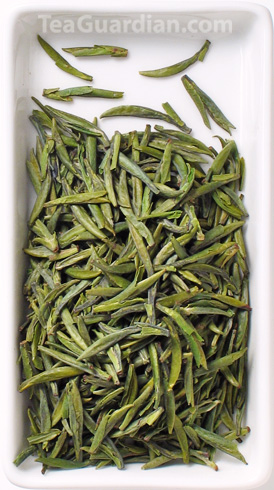
A premium quality Shihua shows evenness in leaf size, colour and shape integrity
míng•shān shí•huā 名山石花, semi-flat style wok-roasted green tea
literal translation of the name: Flowers of the Stone
origin: Ya’an, Sichuan
it began as leaves of the bamboo
Since the 1960’s, semi-flattened wok-roasted leaf-shoot green teas produced in Sichuan had been known as Zhuye Qing (Bamboo Leaf Green) 竹葉青, the same name as a popular Chinese wine. Some say the name was suggested by a so and so admiral (1) because he thought that the tealeaves look like the shape of bamboo leaves. Semi-flattening young tealeaves had been practiced in other regions and provinces anyway and they look similar, but since the naming by a famous person, the Sichuan tea became popular.
That was good after the 80’s when farmers could sell their own harvests for profits. Everyone was happy until one single company somehow succeeded in monopolizing the name for their products in 1999. Other producers who have been relying on this name were forced to change their product names. Some have chosen the name Shihua. From leaves of the bamboo to flowers of the stone. So much for metaphors.
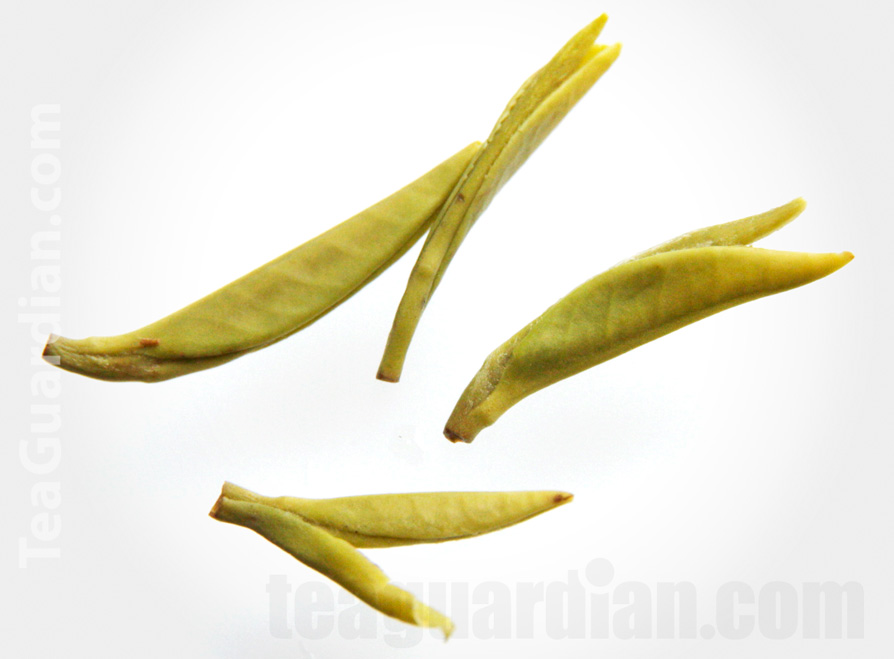
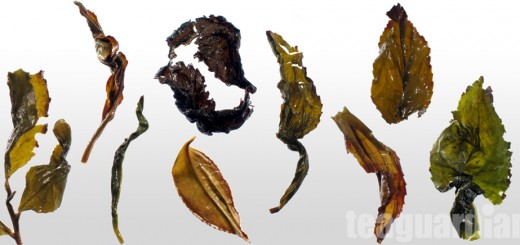
the infused leaves of Mingshan Shihua (名山石花), similar to Emei Zhuyeqing (峨眉竹葉青), both green tea
While the tea of the monopolized name is produced in Emei, the commercialized tourist mountain with showy Taoist temples, Shihua is produced in a few places in Sichuan, as such productions have always been. We have picked a tasty one from Mingshan (translates: Famous Mountain, though the name does not really describe the popularity of the location) to review this time.
Now that most farms producing this tea produce also Mengding Ganlu (2) (one of my favourite green teas), and they are harvested from the same group of tea bushes, I’ll compare the two in this review.
appearance
Rather than curling the leaves to reveal the downy hair as in Ganlu, the hair of the leaves in Shihua are flattened and rubbed away when they are pushed against the wok during roasting, as in other flattened wok roasted green teas. The ideal is to make the leaves a little glossy. The result is achieved through repeating the forming process by shortening each roasting session. With this, the leaves are rubbed against each other and the wok a lot more time but without over cooking.
The dried leaves of premium grades are generally 12 to 20 mm long, telling the size of the tiny young shoots that the pluckers have to nib off from the branches by hand. They are also mostly only shoots, or shoots with scale leaves (the tiny protective scale-like leaves that cover the shoot before the shoot flushes).
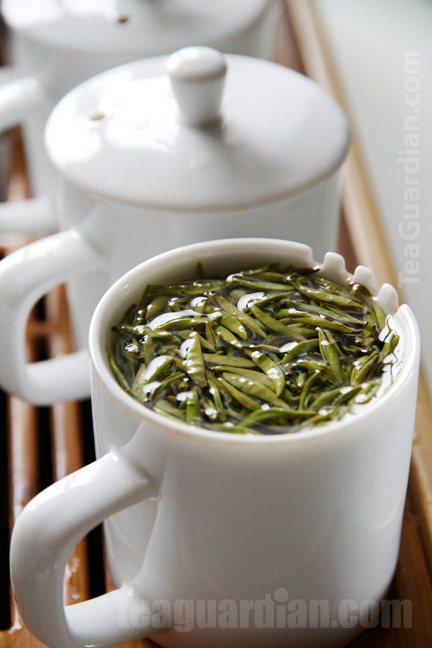
Shihua being infused in a taster’s mug during a tasting session
taste
This more rigorous contact with pressure and heat during processing gives the tea a higher sense of fire than Ganlu, broad-brushing the taste profile with a general warmth (comparative) and more accents of grain than floral. Perhaps that is the underlying factor why that famous admiral gave it a Chinese wine name.
It also tastes a lot sharper than the downy and rounder counterpart. A strong infusion can easily be made though you’ll find a fine Yixing pot very useful in harmonizing its many accents and tones. Forcing it in porcelain still gives you some striking results, though a slightly un-balanced profile.
Like Ganlu, Mingshan Shihua is a very delicate green tea with fine unique characters that deserves a little more attention for degustation. Casually infusing it in a large mug or 6 cup teapot may not fully realize its value.
health notes
Those who wants green tea but turned away by the “chilling” (or cold) TCM nature of other green teas may find this one a lot more agreeable. It is a higher fire green similar to Dinggu Dafang, and over the more popular Longjing. However, if I were to choose only one for a weaker stomach, I’d still recommend trying the Longjing first, because of the rarity of the other two. However, when you find Longjing not warm enough, Shihua is a great tasting choice.
buying tips
Authentic quality Shihua is rare in the market, or for that matter, even so for the monopolizedly named Zhuye Qing. Because of this rarity, selections of acceptable quality most often has a slightly higher price tag than other similar quality green teas. That is also because it looks so delicate and fine that it easily stands out as an expensive tea. Using it as a gift, therefore, is one key channel of sales.
Other major green tea production provinces, such as Jiangxi, Zhejiang and Fujian, have their versions of “Bamboo Leaves Green”, and they look kind of similar. A lot of the times they are sold as Zhuye Qing, but mislabeling is so common place and disgusting that I don’t even want to repeat my criticism in this review. Some varieties have their own merits, but the Sichuan version is outstandingly fine to justify for that extra dollar, if you value the difference.