Classic Style Phoenix — Xingren Xiang Dancong
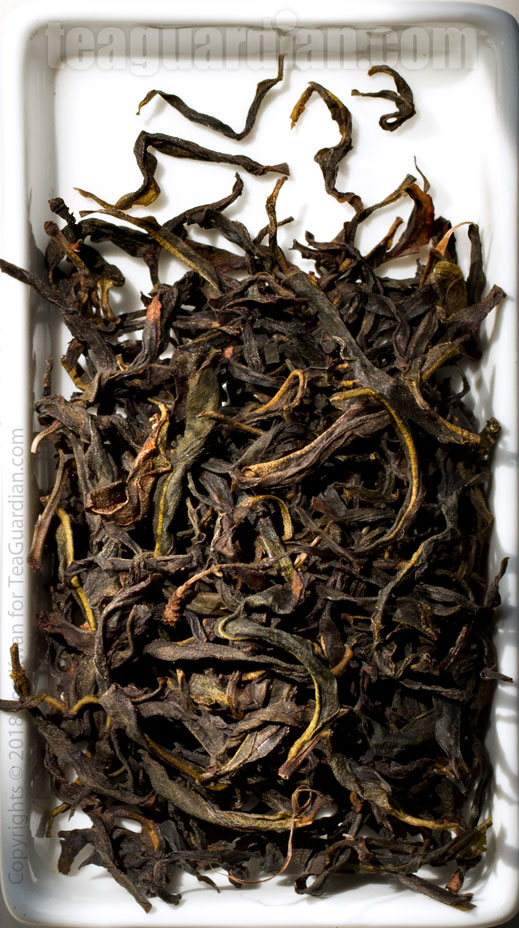
Phoenix oolong Xingren Xiang Dancong, aka Juduozai, Ju Duo Zai, Orchid Gratus. A neutral TCM character traditional oolong tea
A few people have asked me whether there are other classic style Phoenix oolong except the popular Milan Xiang — better known to some in the English name I gave it 20 years ago, Honey Orchid.
Indeed there are quite a number of Fenghuang Dancongs that are meant to be baked to a deeper degree than bouquet style ones. Honey Orchid is only a name made better known because of various commercial conditions. Let’s look at another variety that is far rarer in production quantity and much less commonly known, but as highly regarded in the world of Phoenix connoisseurs.
Juduozai — teeth of a little saw blade
Juduozai, the cultivar that yields Xingren Xiang, literally means teeth of a little saw blade. Ways that Chinese farmers refer to their world never stops to amaze me.
To me, the plant looks almost identical to the more dominant variety Bai-ye. I needed to be confirmed by the local farmer. They say even the fresh leaf smells that almond aroma. They refer to the Chinese almond, popularly used as an herb for soups. Xingren Xiang translates as the Fragrance of Almond. I am quite familiar with the TCM ingredient but cannot really agree. It does smell nice though.
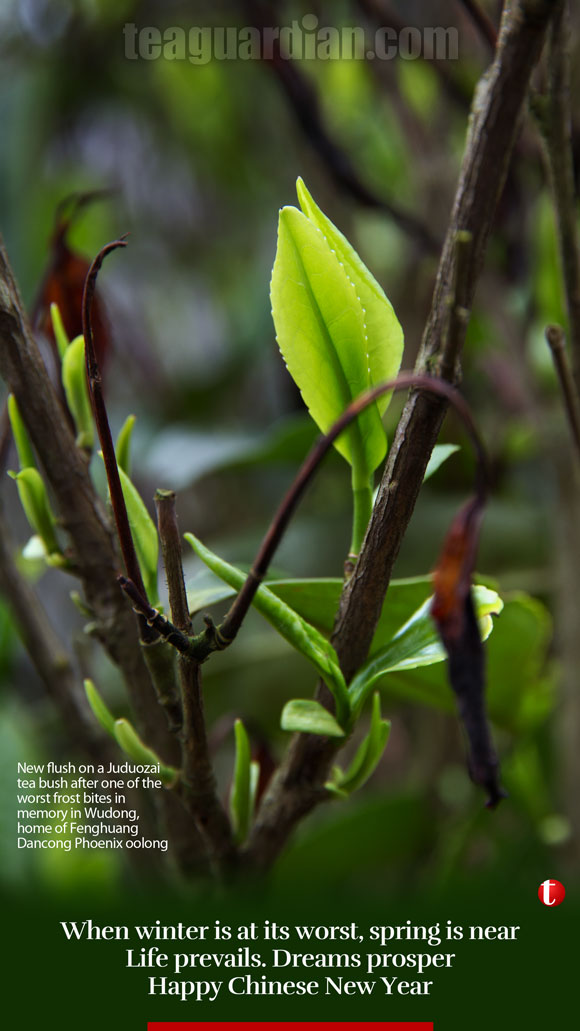
New flush on a Juduozai tea bush after one of the worst frost bites in memory in Wudong, home of Fenghuang Dancong Phoenix oolong. We have previously used the image to make into a poster to share during Chinese New Year
According to Huang Bozi, the pioneer and most respected specialist in the taxonomy of Fenghuang cultivars, the oldest living Juduozai was a cutting made in 1966 from a 300 year-old tree. The mother tree died in 1970, but her off-springs are now one of the major cultivars in Wudong, where home has always been for them.
Wudong, the mecca of Fenghuang Dancong
As mentioned in other articles, most farmers in Wudong do only one harvest a year. They are not lazy. If you see how they work in Spring, laying back is the most remote idea. Many do not even sleep for days in a row. They need the plants to store up the amount of nutrition for maximum taste and aroma substances in the leaves, the natural way.
Different cultivars bud at different time in Phoenix. Xingren Xiang is amongst the earlier ones, together with Honey Orchid and some others.
Plucking at the wrong size is a sin. The month of April is crazy in Wudong. Farmers compete to hire pickers lest the leaves will overgrow to become a lesser quality, or wasted altogether.
( read production of Phoenix oolong )
Then there is competition for space to spread and sun the leaves before actual processing. Without proper solar input, a Phoenix that can score 10 can become 6, at best. That is why weather is vital during harvest for these traditional farmers.
Key to all classic style oolongs
Besides the usual processing of Fenghuang Dancong, classic styles require the additional step of deep baking. For any oolongs to go through deep bake, timing is critical.
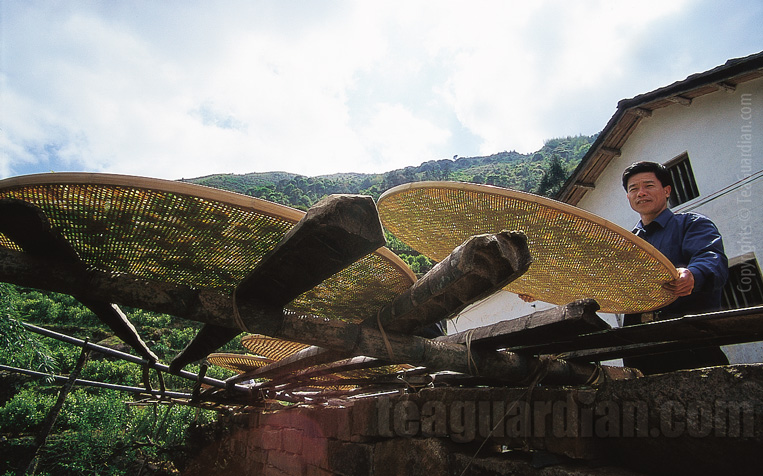
Tea farmer taking a sieve of leaves to wither in the afternoon sun. The Yau’s family garden, Wudong, Fenghuang
To those generations who have been brainwashed by concepts born of industrialisation, temperature, duration, and pile thickness maybe the only factors when considering how a tea is to be baked. That is the way they have designed the processing for black tea and that for most green teas. Traditional oolong is more complex. There is still in the leaves active enzymes. Drying the surface completely too soon simply traps the molecules to suffocate them. Turning what could have contributed to quality to something bad. This is not an understanding shared by all Phoenix producers though. Funny smells, coarseness in texture, inconsistent body in the taste profile is not uncommon in products of this label, regardless of the price.
Bad money drives out good
Popularisation of the poor practice of extremely short infusion time ( in the name of gongfu cha ) helps to disguise poor quality. This coupled with the flooding of the market with under-trained tasters, over-certified so-called tea sommeliers, and the alternative reality manufactured through the internet, it is unsure how large a proportion of Xingren Xiang in the market is poorly baked. However, it is easily observable in the source and quite predominant in major wholesale markets in Mainland China.
Bad money drives out good.
Proper finishing of this classic Phoenix oolong requires patience not only in the baking process, but also a wait till the maocha has rested enough. Yet in a world of fast profit, Gresham’s Law applies, tragically.
There are even so-called bouquet style ( aka qingxiang xing ) Juduozai. To me it is basically semi-raw material sold as product.
Not to mention mis-labelling.
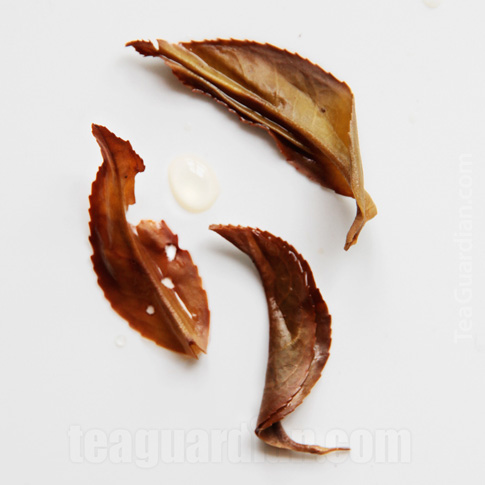
The appearance of infused leaves tells something about the nature of the tea: Xingren Xiang Dancong (杏仁香單欉)
Taste profile of Xingren Xiang
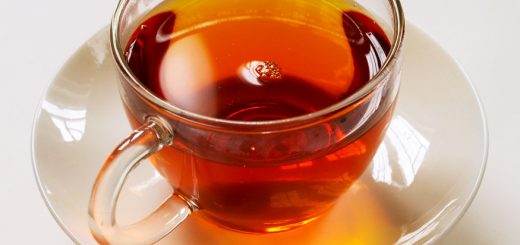
The infusion of a good quality Xingren Xiang should have a soft, smooth and deep aroma of sun-dried sweet date in an overtone of raw honey with hints of woodsy spices on accents of butter. The liquor itself, when properly prepared, has a silky texture and a delicate full body comprising kumquat peel, apple, anise seed, malt, cream with a sweet touch of Chinese liquorice.
There is a general misconception that traditional oolongs should only be prepared in the gongfu cha style of infusion. This is untrue. I shall discuss more about the difference between the “gongfu” style and conventional “5-minute” approach in another article, but for now, I shall state that properly infusing a Juduozai classic Phoenix oolong for enough time is the only way to experience its wonder.
If the tea that you have has that same label but yet cannot quite stand longer infusion, either you make tea poorly or those leaves are not a good quality Xingren Xiang at all.