How Fair is Fair Trade?
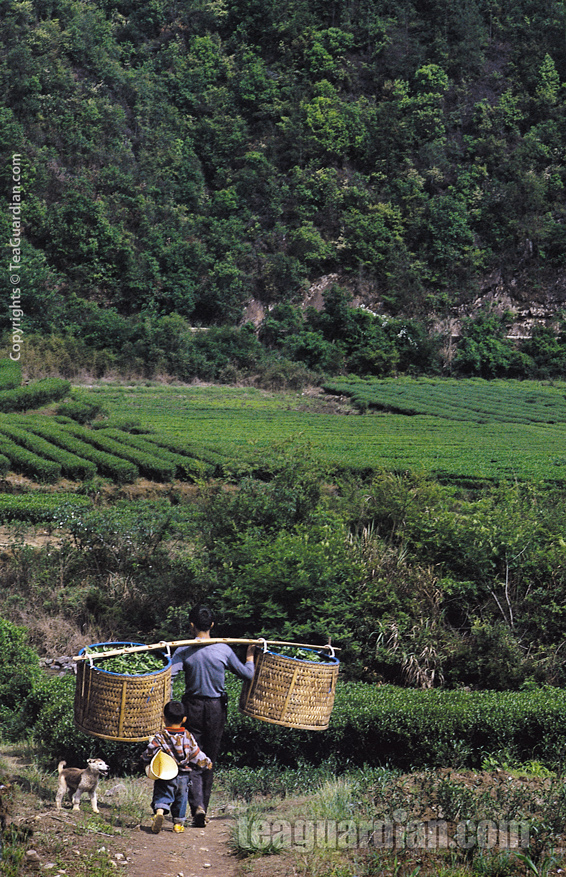
Man carrying two baskets of fresh tea leaves back to his home processing shack while the son following. Wuyishan, Fujian. Small stake tea farming is the back bone to the success of the tea economy in China.
beyond fair trade — an open economy
Ten to twelve women have now gathered at the entrance of their family complex, having had rice soup and stir-fried noodle for breakfast in the staff kitchen/canteen. They busy themselves with chats and jokes, as if they were some middle-aged school girls about to go on a picnic. I know it’s a hard day’s job of leaf-plucking ahead. I have climbed these steep slopes of scattered tea gardens — it’s a challenge to me even not carrying anything.
Xiao Fen and her folks now run a busy tea processing plant in their multi-building complex, accessing scattered tea gardens in various peaks around these scenic mountains here. The family has become a small enterprise employing many skilled workers from neighbouring villages. She should not have much to complain, other than the rising salary.
“Last year the going rate was 55 CNY a day for these pickers, this year they won’t even settle for 70”
All such migrant tea pickers are in high demand during peak harvest seasons and it is understood that the train ticket, room and board are basic provisions in addition to the salary. Highly skilled pickers, such as those for Phoenix oolongs, demanded 85CNY last year. That is over 14USD a day. It is an open economy for labourers and the law of supply and demand reigns.
Xiao Fan never heard of the concept of “Fair Trade” and she thought it sounds ridiculous when I explained that to her. “If the salary you give to the worker is good only for her to live like a slave, how can that be fair?” That is a reasonable logic.
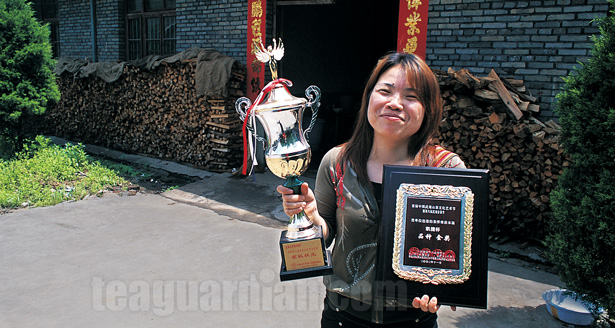
Xiao Fen shows off her trophies for best cultivars golden awards in two provincial competitions. She could have never dreamed of this when her green leaves were gathered at extremely low rate, if at all, for the national company to process in bulk 30 years ago. Photo courtesy: Tea Hong
However, it is not all rosy in China. A whole minibus taking pickers to the field fell from a badly made road from a cliff in 2005. All 11 young girls were killed. There is not much of any labour law for these agricultural workers to guarantee any compensation for the families. It is totally dependent on the good will of the farm owners as to how to compensate.
Not all tea regions operate like those along the more progressive coast and other exceptional provinces such as Sichuan. In land-locked Hunan, for example, agricultural workers are in higher supply than demand and they are not as well off as their counterparts at the coast. Some get as little as half the pay as their more fortunate counterparts in Fujian, but that is still a far cry from the condition in Sri Lanka.
Taiwan sets the model
Taiwan has set a classic model for this rise of the small tea farm (as opposite to tea estates/plantation), more so than Japan. They have focused in quality and diversification of varieties so there is not only competition and segmentation of the tea market, but also a spiraling upscale of price as the society grows more affluent. The consumer enjoys ever improving quality, the producers better paid.
Followed by the tens of thousands of farmers in China, such model has repeatedly proved to be successful.
“If I can sell tea to this world, it will be huge help to our villagers”
People elsewhere are learning. Such as those in the village of Lwang in central Nepal. The slanting slopes of their super scenic mountains of the Himalayas have proved not to be productive enough for anything else. And they know they cannot rely on selling the leaves to big plantation owners for any reasonable future. They have seen others stuck in poverty this way. They have formed a farmers’ cooperative, and with some help from the government, a small processing facility is now producing high quality products that the young village representative Kumar is trying to sell directly to dealerships in different parts of the world. “In 2005 all the villagers invested money to buy (the) production machine (basically a standard tea roller)… Nowadays production is high but there is no any one for marketing… If I can sale (sell) tea in (to) this world it will be huge help to our villagers…”