
Leo Kwan: How Tea Has Chosen Me
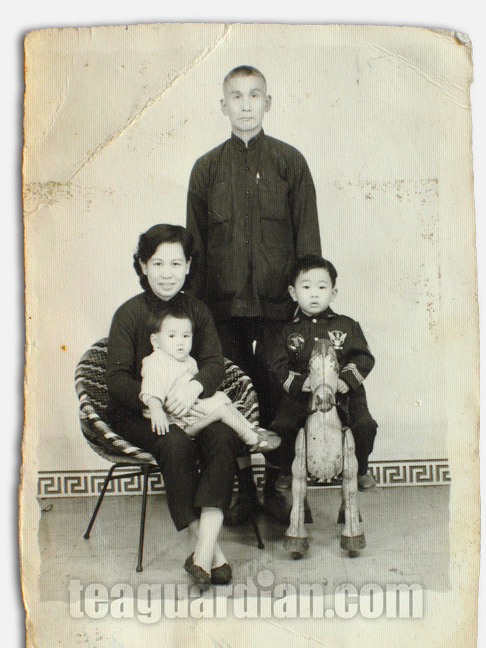
Grandpa standing in for Dad in this family portrait. My father was absent from home so much that I saw him very few times in the early years. Mom’s perseverance must have given us the optimism and emotional strength that pulled us through all those difficulties during childhood. I guess it has much to do with the strength of character in all my sisters too. Yes, that expressionless kid on the wooden horse was me.
Cultural Revolution: triggering my connection with China
Throughout the infamous Great Leap Forward and Cultural Revolution, our relatives in Communist Mainland China relied on my mom to bring them meat, rice, oil, and other provisions. We had little for we were poor, but these people had even less and they could not buy anything even if they had cash.
The summer before I began high school, I went with Mom to the Mainland on one of her usual supply trips, bringing with us a big Horlicks glass jar filled with fried pork chops, which I thought could have been left home for me and my sisters. One of the cousins I met for the first time took me on his bike to town for longan (the Chinese summer fruit the size of grape with a thin shell and translucent, sweet juicy meat) and I saw something that had since defined the incomprehensible stupidity of Cultural Revolution.
A thin man was chained to a pole in the town center, wearing a tall conical cap. It must have been four feet above his dusted, uncombed thick hair; I had to look up to read it even I was quite a few yards away from him. “Down with the ox and snake devils!”, one of the usual contemporary denunciation slogans, had been brushed hastily in black ink on the vertical length of the head piece. The man half dropped his head to look into the dirtied stone pavement a yard in front through his wrinkled and drooping eyelids, hiding his colourless and expressionless face in the shadow of the mid-day tropical sun.
A country without conscience
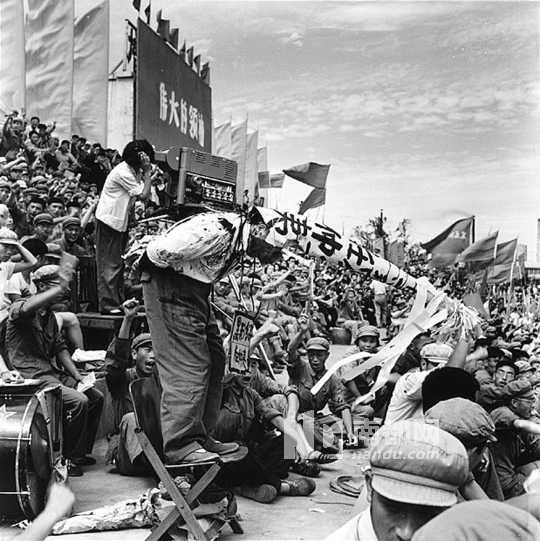
Millions lost their lives to the violence during Cultural Revolution. So far, no official figures has been released nor any formal investigation has been conducted. Proposals for a museum have been buried. Above: Ren Zhong Yi, a top political leader and a suspect by Mao, was humiliated in one of the millions of damnation gatherings. What appears in the photo is “civilised” already; much brutality and evil acts happened to people of all ranks and positions in Mao’s plot to reinforce his personal power. Photographer unknown.
On the right an exhibit showed the evidence of his ‘guilt’. A lamp with a red plastic shade dangled 2 ft above an old wooden table from a stick. The table top was perhaps 3 by 5 feet, which perimeter was roughly fenced a few inches high with rough wooden strips. A few eggs laid on top of a thin layer of hay on it, two were cracked already; the hatchlings struggling through the tangled straws with no seeming direction.
The man was condemned of being an American capitalist trying to profit by changing Nature. I was shocked that such an accusation could at all be established, and in front of the thousands of people in this town. I was more confused, though, that such degradation of the human dignity, even if his little “invention” were really illegal, should ever take place, and in Zhongshan, what had been an image of the civilized home town of Dr Sun Yat Sen, my childhood hero.
It was obvious to me, even as a young teenager, that China was what it was because the country seemed to be operating without a conscience. The people without souls. I had not known at that time, however, that atrocities of much more dramatic degree and scale had been happening throughout my parents’ home country. The excitement of high school soon took up all my attention…


Hi Leo I bought your book ” Not all teas are created equal 14 years ago when we were building the Hong Kong Disneyland Resort. (I spent 27 years with Walt Disney Imagineering building Theme Parks around the world and was a big coffee drinker until I read your book) You converted a lot of us from coffee to tea drinkers I loved your and began exploring teas. Continuing my exploration when we built Disneyland Shanghai. Unfortunately I loaned your book to someone years ago and never got it back. I would love to buy another one. What is the best way to get one. Thanks very much Frank
Hello Frank,
You made me feel very happy saying that a lot of you ( and your friends? ) have been converted from coffee to tea because of my book. I hope it is fine tea that will enrich your health and enjoyment of life.
AS for that particular little book, it has been out of print for 11 years now. Over the years I have given away most of the few personal copies I have. There is only one remaining in my personal work drawer now.
Please let me check if I am able to ask for favour from people in my previous company to find if there are any forgotten copies. Send an email copying this text through the contact form so if we have luck, I shall have someone contacting you.
Hi Leo,
I enjoy reading your stories and tea articles very much! Thank you for sharing the story of you and your family. Every piece of your articles about tea and the history of China is very genuine. I love to share your article frequently on my facebook page and company page too! I am a Cantonese Canadian who live in Toronto, Canada. Happy Moon Festival!
Hello Vicky,
Nice to know you. Thank you for sharing my articles. Please do share your comments and any ideas here! We can always improve.
Wishing you success in your business and a happy life in Canada.
I’ve read your inspiring story previously and enjoyed it again tonight. Who knows where the river of life will take us? In 2012, I quit my corporate job to travel for a year. I spent six months in mainland China studying intensive Chinese and travelling throughout the countryside by train, bus, or whatever local transport passed by. In Yunnan, I fell in love with Pu’er tea (and a woman from Guangdong)–my life has never been the same. Cheers.
That is indeed a romantic story about tea! May I ask you to share it by writing for us an article with photos?
I require stories like this in my life to remind me of how well off I have actually been in my life. Mr. Kwan grew up and abode in such hardship, but seemed to have thrived so much in his spirit that he went on to create such a contrasting life for himself. I hope and pray his and his family’s continued success and I am grateful to see this trade of beauty for ashes.
We all have our individual paths in Life. However, it is ever a bright moment when one discovers a torch in another path going in the same direction. It warms the heart and makes the journey a lot more enjoyable.