The Significance of Quality
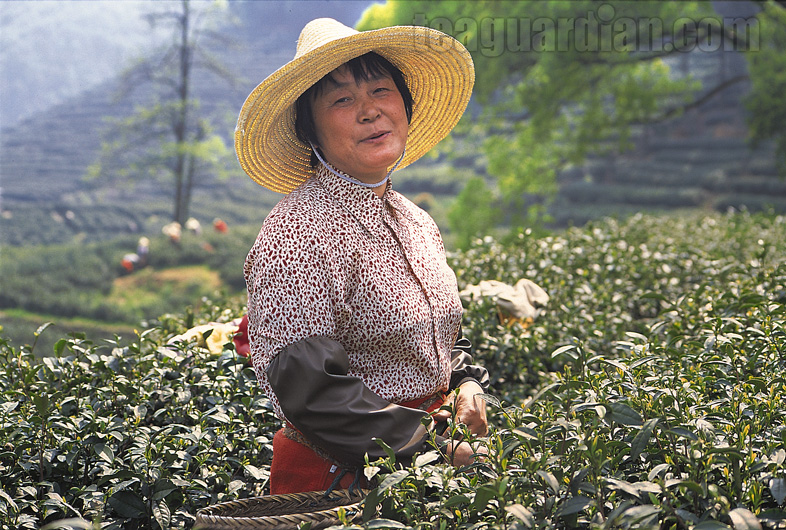
Ms Ruan of Jiangsu comes to Hangzhou in Zhejiang to do the plucking for Longjing every Spring to earn the much higher daily rate here.
the ham and spam in tea
Fine tea to me is a totally different product from mass-market tea. More different than Brie de Meaux is to Kraft “cheese” singles; or Ibérico ham is to Spam. On the other hand, very few people are aware of this because of the lack of popular access to such quality. I can live with a luncheon meat sandwich once a while, but I can hardly associate any bottled tea as tea at all. To me, the real thing is indispensable. It is my simple daily pleasure and health aid. This is the core motivation for my advocation of it.
However, there is a bit more than what meets the palate.
real fairness comes from empowerment

Arumu, 70, remembers the times when the English managed the tea estate. “Our lives were better back then, than today.” He used to work in a Sri Lankan plantation. Photo: Knut-Erik Helle / justworldphoto.org
Mass market tea, produced through automation and low-skill labour, takes up over 80% of the tea trade. The remaining is made up of special tea such as oolongs (including low grade ones), crafted teas (aka textured tea, i.e. tealeaves which appearance is styled with handy craft) and a tiny percentage of fine teas. The situation is improving, but only gradually.
With a product structure as such (and a predominant near-cartel trading system in the West that is yet another problematic topic), production of most tea is transfixed at the era of early day industrialization, where resources and capital are in the control of a few hands. The workers, since not much skill is required of them, are considered expendable. Their work conditions reflect that. Horror stories that I had no previous imagination of were told from production areas in different parts of the world.
Any systems derived by the cartels in the name of being “fair” to the laborers are feeble if not fables. It seems to me that it is only through the empowerment of the workers that they can have a better basis for negotiation with the capitalists, whether on work conditions or on salary. It is only through a demand for skills in production that would render power for the workers that is a token for fairness. In a capitalist’s world, when the value of the worker is part of the production resource, the capitalist has no choice but to put it in as part of the cost. No other “conscientious” plans basing on the “good will” of the capitalist can give the same guarantee. That is why I love traditional hand-made teas, other than primary gastronomical reasons, for their demand of skills in the workers.
in the true spirit of capitalism, for the benefits of all

Master Chen in Fenghuang (Phoenix) is a happy man. His tea is selling for good money. Genuine Phoenix oolongs are still traditionally cultivated and produced so the taste characters are unique. His tea garden is very small and kept traditionally so he hires extra workers only during harvests. Chen married off her daughter with a new house and his sons are joining him after school. He said the sons have decided to pick up the family business.
Take the production of Phoenix oolong as an example. While the average agricultural worker in China makes around two hundred USD a month (1), the tea farmers in this region can be buying properties in nearby cities for investment. Their tea pluckers (the lowest salary in the line) earn 35 to 45 USD a day, plus benefits such as train tickets and room and board — that is over 6 times (2) the average, and many times that in the Indian subcontinent and Africa. The farm owners even have to compete with better benefit packages to hire them too, especially in peak seasons, because quality of the pluck directly influences the quality of the products. Traditional Phoenix oolong is so well-regarded that the demand for it in the domestic market alone is enough to sustain its growth.
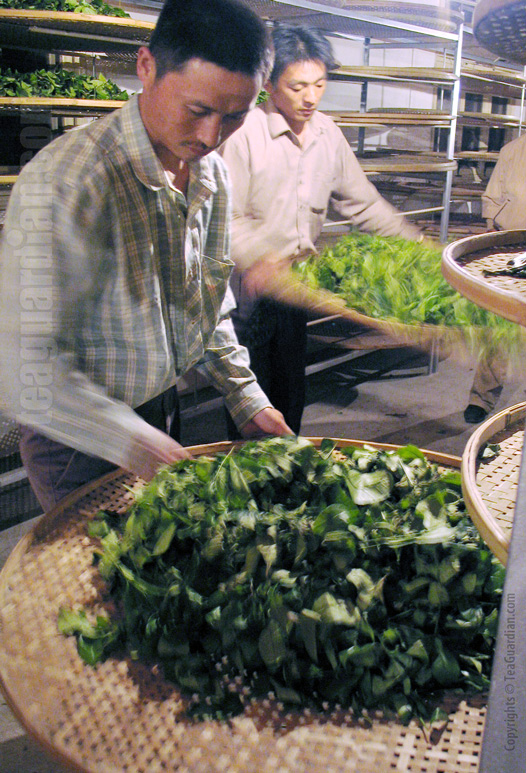
Master Wang used to have his own farm in Wuyi but he was not managing it well so he sold out to a neighbour instead and works as a fermentation specialist for another. He is not making as much money, but a fair living a few times the average wage of an agricultural worker. Production of traditional oolongs takes skills. His skill set is in demand.
Since all over this region there is no single “big brother” tea company or tea farms, the small stake tea gardens all compete to make better tea for better selling price. As quality generally advances, so does the amount of money paid to every single person in the production line, in order to maintain the quality of skills in the production. The worker, by way of this demand in production skills, is competitive and not as easily replaceable.
The Significance of Quality
I am not saying that all tea workers in China are in a similarly ideal situation, at least not when the majority of tea produced is still geared towards price competitiveness rather than quality superiority. However, when more consumers begin to understand and demand for quality, the pressure will be on the producer side to learn to reward the better skills of the worker.
It is not through artificially installing third party monitoring such as the so-called “Fair Trade” that can make it fairer for the less fortunate in the less developed world. It is only with the true force of the market that can sustain a world without slavery or near slavery in some tea production countries, and you the consumer pretending not to see it while buying cheap mass-produced tea.
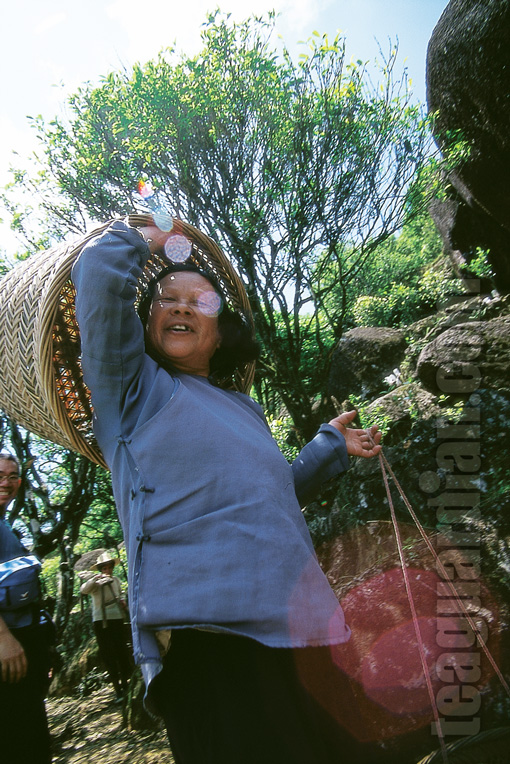
One of the plucker ladies happily going off to work after their 11 o’clock lunch. Wudong, Fenghuang
The significance of quality, is therefore a key to the sustainability of the development of humanity at large, at least in the scope of tea, if not other things as well.
for your own sake
Well, if you do not care much about what those country folks are doing, and if the fine taste of tea fails to impress you, you may be concerned about your own health.
The health benefits of tea drinking has been studied intensively in the scientific circle for a couple of decades now and the results are confirming some old believes. However, the salutary benefits come with a catch — your tea in the PET bottle or instant mixes are not delivering the effects. Data confirms that finer teas are not only more potent with their higher theanine and flavonoid contents (3), but also less of those things that people put in tea during production and wouldn’t tell you.
In confronting the never-ending challenges of life, enjoying a decent cup is an honest daily pleasure that everyone deserves when he knows a fine tea from the good ones.
footnotes
1. Original writing of this article in late 2010 stated the salary as about 100 USD according to Ma Guangyuan, The Dramatic Increase in the Peasant’s Income has been a Big Misunderstanding, 2009-08-17, Website of the Southern Posts (China). However, much has changed and we have since obtained figures from different real life sources as around 200 and updated this article in 2015. This double fold increase reflects in reality the accumulative inflation during that time span.
2. Updated in 2015 from the writing of 7 to 8 dollars a day and only 2 times the average as written in 2010. In more remote areas, it can go up to 50 USD a day in peak seasons. This reflects how rapidly the economy of China is changing, as well as the rise in demand of pluckers.
3. More in the Tea & Your Health section