Is Pu’er Cha Bing an Investment Tool?
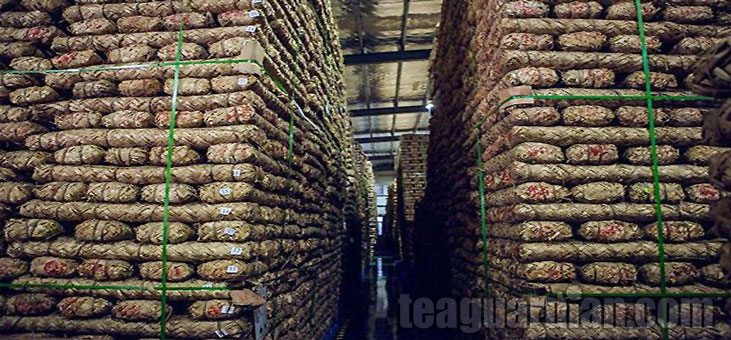
The pu’er tea annual throughput in Yunnan was 130K tons in 2015, a 13% increase year to year. It is unknown how much has been sold as loose tea and how much as cha bings and other compressed tea forms, but the latter is a significant percentage in most pu’er factories. The rate has been increasing at such speed since the early 2000’s.
Each “small” bamboo wrap here contains 28 pu’er tea discuses, in the traditional 7×4 configuration.
Suppose the original factory does make the best quality, who is there to judge if that quality is upkept through storing a rice paper wrap tea through, say 20 years? And at that point of time, how does this original product compare to an imitation? This brings us to a major issue about the whole subcategory of pu’er: Quality of storage, packaging and handling hygiene.
Since such standards do not exist, not to mention a way of monitoring claims of compliance to a standard, there is NO means to understand the quality of any piece of tea discus but to trust whatever the seller claims.
Another angle to look at it is that the people who are paying for it do not care about the taste quality of the discus. The piece is just an artefact like any other antique. This brings us back to point two.
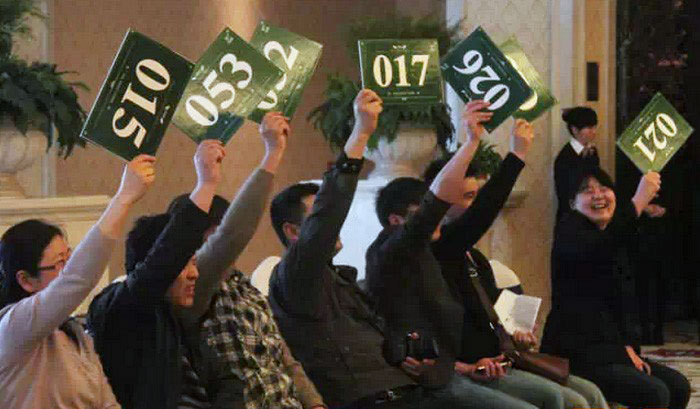
Bidders during a pu’er auction
The auction market for pu’er in China is heavily manipulated. Auction records help to set trends for retail and private sales of the commodity. Someone is benefiting from such records.
Caution: Category Killers on the Loose
Some Mainland Chinese business person with certain connections might now have been shown the translation of this writing and wittedly create some kind of fancy looking certificate to sell to sellers such that the products would seem to comply with some funny name standards by such and such authority. However, the foundation to any trusted quality system and reliability of certification is a respected legal system enforced by uncorrupted and effective regulatory bodies.
Before the government of China is developed in such aspects, which would take quite some time, associations or other bodies concerned should be taking up the lead to study and layout plans to design such standards and the ways to implement them, rather than impulsively drawing up another unrealistic move such as the IGPRPC designation of origin, which has become just another laser label that one can buy from one of the shops in the wholesale market to put on anything.
We feel obliged to tell the facts and reality because we think that the trade needs to correct itself from harming its own long-term development, and from discouraging the popularization of real tea. It is only through empowering the mass with knowledge that they can make intelligent decisions for themselves; that any culture, be it tea or any other culinary category, or any other human activities, arts, technologies, etc for that matter, can prosper.
Cha bing is a form of tea. It is not a commodity for speculation. One may collect them much like wine with the intention for consumption, and save a percentage of the value appreciation. Turning this tea product into financial trading is dangerous for the trade, stupid for followers, and evil of the defrauder.
Like wine, pu’er does mature when properly packaged and stored. Well matured pu’er is worth better. However, see it as just another bottle of Château Lafite at best. Most products are not.
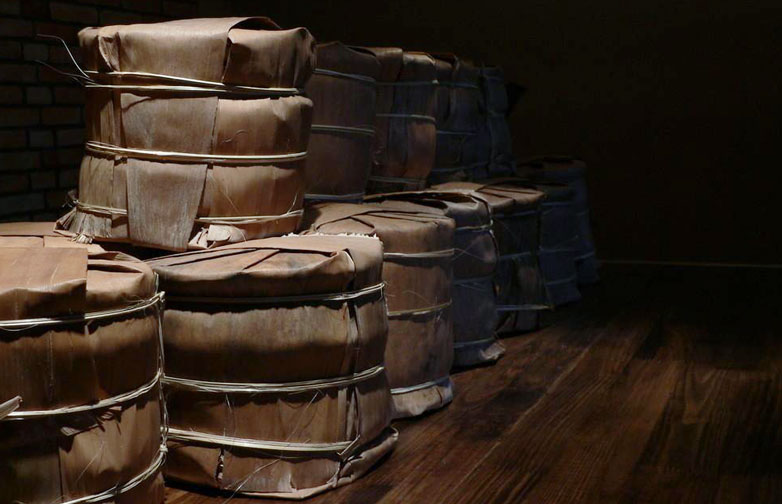
Pu’er cha bings in columns of seven discuses each, wrapped in bamboo bark, as in the old way