“Raw” Puer or “Cooked” Puer?

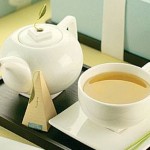
Infusion colour is illustrative of the fact that a shengcha puer and a real puer are two different kinds of teas. The tealeaves for the above two glasses are from the same producer and are of the same grade and same price. The right one is a shu cha and left a shengcha.
what is a “raw” puer?
Puer ( formally Pu’er, Chinese: 普洱 ) teas that have not undergone post-fermentation are sometimes labelled as “raw” puer.
“Raw puer” is a transliteration of the Chinese expression “sheng-cha” ( 生茶 ). As an adjective, the word “sheng” means not cooked, not ripened, or alive. The expression “shengcha” initially refers to the dried tea leaves of the puer variety that were meant to go through further processing, such as steaming for compressing or post-fermentation for darkening.
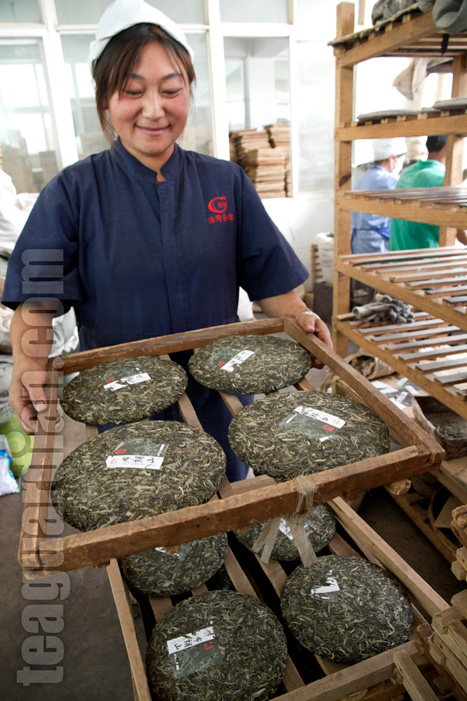
Worker filled a rack layer with freshly compressed cha bings. This happens to be a shengcha puer from the famous region Bulang-shan.
shengcha, maocha and crude tea
In the work flow of traditional tea production, all leaves that have gone through the vital processing stages but not yet gone through finish-processing, i.e. sorting, re-processing, drying etc, are referred to as maocha ( Chinese: 毛茶 ). Maocha is sometimes translated as crude tea. However, the word crude is not as descriptive as the concept of maocha, so we think the romanized term is more appropriate in our tea discussions.
Maocha and shengcha are two terms for nearly the same thing in the area of puer. The difference is that maocha defines the tea from the perspective of tea processing, while shengcha from a consuming view-point. There is also a subtle difference: shengcha can be sorted and properly dried while maocha isn’t.
When people discovered that consuming maocha puer could be marketed, the term shengcha is preferred so the product does not sound like it still needs more work for the consumer.
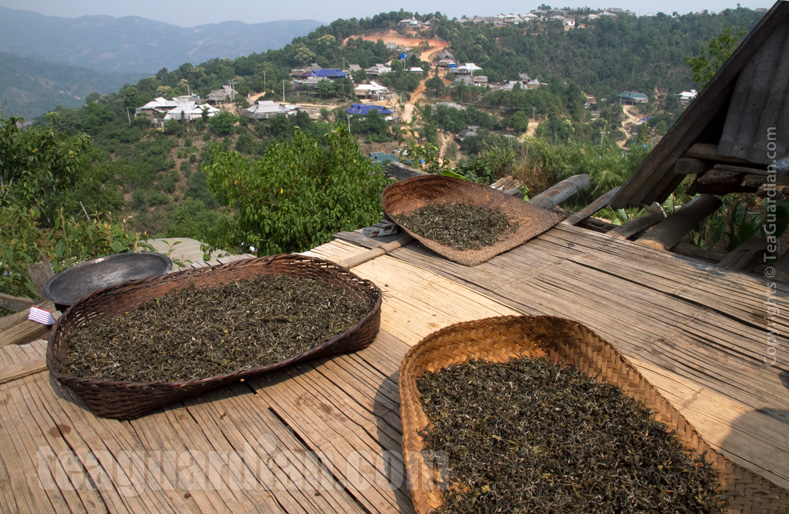
Tea being sun-dried to make maocha on the roof top in a tea farm worker’s home in Yunnan. This is obviously for home use. Notice how the tea has already become darker colour upon long exposure to the sun.
ALL varieties of traditionally produced teas undergo a state of being maocha. In most tea production areas where tea drinking is also a local habit, maocha is regularly used by the farmers and workers. Where tea production is more automated or contained within a continuous or almost continuous production line, the stage of maocha does not exist for a long time.
and “qing” cha?
In the case of puer, the term “qing cha” ( 青茶 ) is sometimes also used for what is shengcha. The word “qing” is used very frequently in the Chinese tea trade referring to the “rawness” of the tea. For example, leaves plucked from the tea bushes are called “cha qing” ( 茶青 ); sun-wilting of the tealeaves is called “shai qing” ( 曬青 ); when a tea is not properly processed and tastes raspy with grass taste, it is “chou qing” ( 臭青 ) — “the stink of rawness ( as in grass )”; etc. That is why “shengcha” discuses ( or disci ) are sometimes referred to as “qing” bings ( 青餅 ) (1).
The term qing cha is also often heard in daily Chinese conversation. However, it actually means plain tea ( Chinese: 清茶 ), ie tea without added ingredients. It has nothing to do tea variety or categorization, but rather a way of drinking, or more often, a way of life, as in Qing cha dan fan ( 清茶淡飯 ) — Plain tea and non-seasoned rice — implying a humble way of life.
The term “qing” refers also to a colour that most would think of green, yet a frequently heard tea category label, qing cha, does not refer to green tea. But oolongs instead. In such context, the term qing refers to the colour blue, as in blue mountain. That is why you can sometimes see people refer to oolongs as blue ( or teal blue ) teas. However, this is another topic.
Perhaps it is this confusing concept, even in the Chinese language, the term “qing” for describing shengcha in the loose or the compressed forms ceased to be popular.
“raw” and “cooked” are thus relative
Let’s come back to the “raw” tea we’ve been discussing. In antiquity, a shengcha puer is meant to undergo a “darkening” processing before it is consumed. A well-darkened puer is rounder and rid of the “raw” taste so relatively it is not so “raw” — it has become “cooked” …continue reading