Is a Semi-fermented Tea an Oolong?
|
Oolong Processing
|
Black Tea Processing
|
| The typical oolong process lasts between 18 to 24 hours, in addition to plucking and the final step of baking, which can be a few days or months after processed. | Most black teas are produced 2 to 6 hours after the plucked leaves are put into the factories. CTC takes shorter time, orthodox longer. Traditional or gongfu black teas, such as genuine xiaozhongs, can take an additional 3 to 24 hours more, due to slower withering and fermentation with restrained or no use of heat. |
comparing half-fermented black tea with oolong
So the abbreviated description that an oolong as a partially-fermented tea is conveniently communicated as something between black tea and green tea. These tea estates just halt the “fermentation” step of black tea production mid-way to deliver the tea “semi-fermented” (I’d say “half-fermented”), faithful to their own story. This way, the marketeers have “oolong” teabags, “oolong” bottled tea, and “oolong” tea mixes, without the need to tell lies, if an oolong really were just a half-“fermented” tea.
The fact is, a semi-fermented tea may or may not be an oolong. Being only partially fermented is only one character that defines an oolong. Not all four wheels are racing cars. On that note, as there are metal boxes with four wheels and there are Aston Martins, there really are low, low quality oolongs and the oolongs that are the most exquisite of all teas. And there are half-fermented black teas. Read the production work flow comparison chart.
What really matters to the consumer, however, is not only the conceptual difference, but what they are getting with their dollar.
-

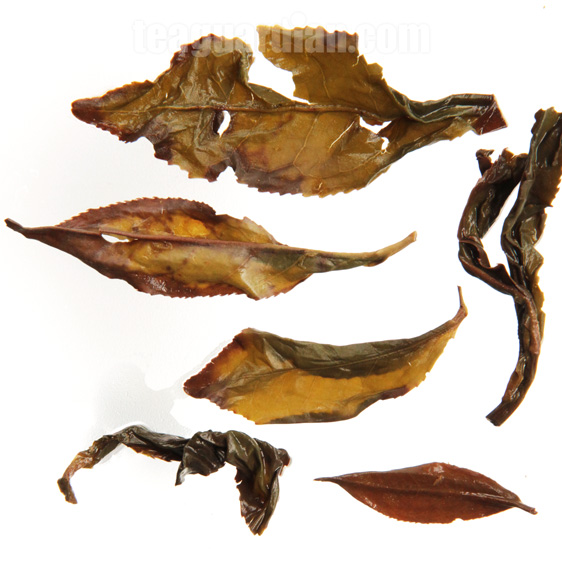
- A classic oolong: Wuyi Rougui Amongst all oolongs, Wuyi Rougui is about medium in oxidation and this selection is a matured one. The leaves are still quite tightly curled after infusion and need to be unfolded with two pairs of pincers. Observe how oxidation begins on the edges of the leaves, because the leaves are still open and the leaf tissue quite interacted throughout the oxidation process. These are leaves matured for over 4 years so some are quite broken.
-
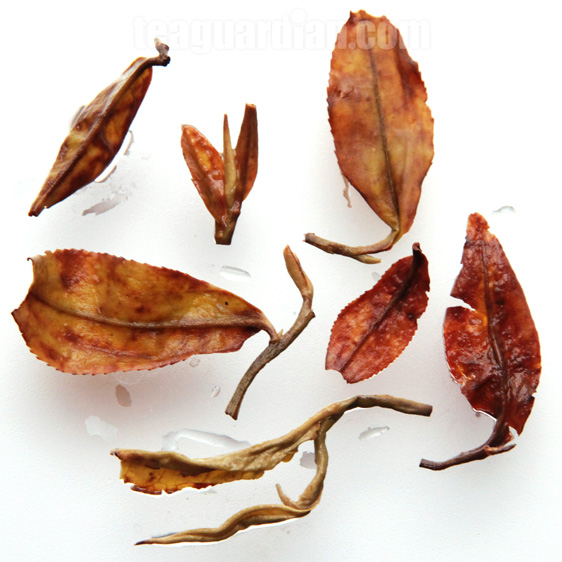
- Nepal semi-oxidized A half-fermented black tea from the Himalayas reviews how the leaves are rolled ( twisted, conceptually speaking ) for breaking the leaf tissues before the oxidation process. It was sold as an oolong. To be fair, however, this is a very fine semi-fermented black tea.
-
- Nepal Handrolled Traditional Black Tea Notice the similar tealeaves are almost similarly oxidized as in the semi-oxidized version. The oxidation in piled fermentation for whole leaf black teas is seldom very even, more so in the mechanized “orthodox” method developed by the West. See how the large leaf in the lower center is like an oolong leaf. This is, nevertheless, a fine black tea.
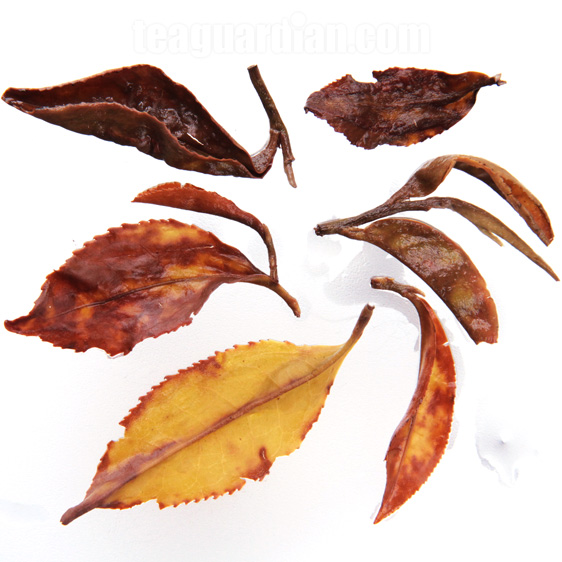
-
- Vietnam generic oolong This light oxidation style is made from a Qinxin cultivar developed in Taiwan. Notice the extremely light yet even oxidation that happens only on the leaf edges.
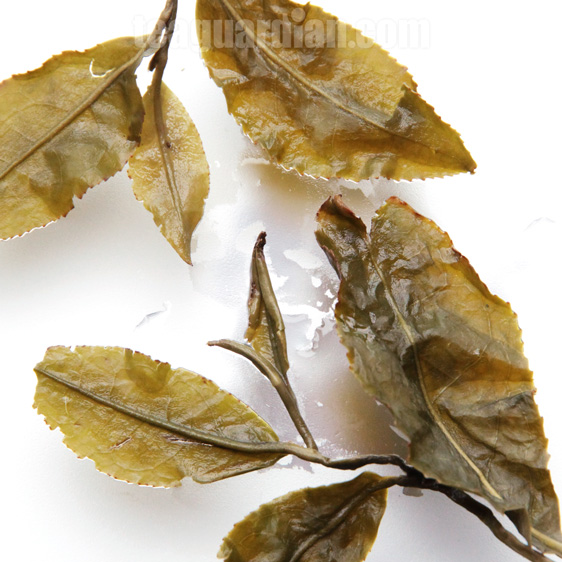
Take note that both the Vietnam oolong and the Wuyi Rougui are developed from specialty tea cultivars, which leaves look entirely different, and the two Himalayan teas are the same leaves, although all belong to Camellia sinensis variety sinensis.
It is the proportion of the unoxidized, even light-oxidation, and leaf-edge oxidation of a particular leaf type that gives the oolong its material characteristics.
a different production setup altogether
Diversity of cultivars and production styles aside, the material nature of an oolong is different from a half-fermented black tea. The long and gradual fermentation process of oolong production yield a biochemical composition so complex that the science community has yet to define. This differs dramatically from its much shorter, hastened counterpart in black tea production, where the leaves are twisted (or curled, as my Western counterparts like to call it) early in the process, tissues broken and juices released in a surrounding of warmed air in this production step.
Seasoned tasters to a wide range of quality and tea categories understand by their experience how different oolongs are from black teas. There is not much to say for both categories of products at the lowest end; however, for better ones, oolongs are always on the upper hand for brightness, fullness and aroma. The diversity of varieties is also unmatched by the category of black tea.
Detail and thorough studies are yet to be made by the science community, but there are already some clues as to what science has to say about the differences in taste and in health benefits of the two…