Oolongs: Minnan (Anxi) Varieties
health notes
Minnan oolongs are normally shorter fermentation compared to traditional oolongs. Its baking time, under the current taste trend, is also relatively short. This render the tea quite green, not only in its colour and taste, but also in its health aspect. In TCM (10) term, this tea is very cold in nature. In effect, that means people who are excessive in food habits (particularly red meat or fried food), hot temper and aggressiveness can have some of their “heat” dissipated through drinking it; people who have indigestion, gas problems, sleeping problems, nervousness, sexual difficulties or menstruation problems should avoid it.
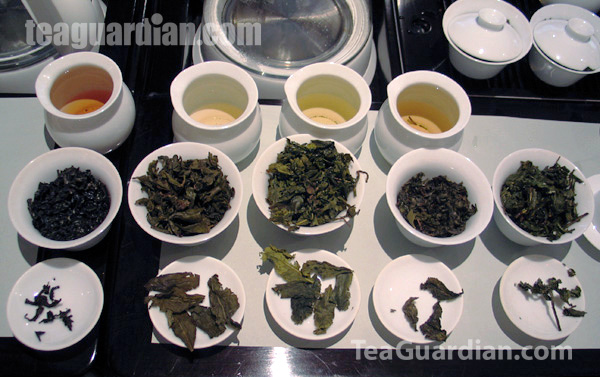
A student’s effort in one of the tea class: the infused leaves and infusion colours of various Minnan oolongs
However, some varieties are long-baked, which is a traditional treatment for sales to outside of the production area, neutralizes the “green” effects and renders this tea friendly for all. Long-baked varieties are generally browner or very dark brown. The dark brown ones can be matured for a very mellow effect, which a lot of connoisseurs are fond of. Browned tea freshly out of the oven is not to be consumed. Its “heat” (TCM term rather than temperature) has to be contained simply by putting the tea aside for at least 3 months before consumption.
buying tips
Like most green tea and black tea regions, tea is plucked the whole year round in Minnan. First flushes taste the best and Autumn harvests (late September) are the most aromatic (11). Both of these fetch the best price. Off season ones, unlike green and black teas, may look a lot more impressive with sharper green colours and perhaps larger beads, and smell quite good too. Not-so-honest merchants may want to take advantage of the less than seasoned buyers with them.
attention for your health
Before you are able to find a really reliable supplier, stick with the first flushes. There is another big reason for it: pesticides. I am not sure if the unrestrained use of chemicals here is cultural or that the nature of the local cultivars is more vulnerable to pests. Maybe it is the dauntingly out-balanced micro-ecology here — they just wipe out all other trees with tea bushes in most gardens, a very bad horticulture practice. It is not uncommon that productions from traditional farms here fail to past EU standards in maximum pesticide residue requirements. Huangjing Gui and Maoxie, two varieties which finer ones are quite pleasing and at affordable prices, suffer the most. The least affected ones are farms which have been confined to producing only the finest grades. Their plantations are usually more sensibly planned and their locations more remote. The need to minimize plucking to maximize output quality also hold them back from the excessive need of efficiency. The other less affected ones are those productions in neighbouring counties in newer tea plantations. Some are even organic. I have, however, not been able to find in these new farms productions with commendable gourmet qualities. Hopefully they will come by soon.
ginseng & milk?
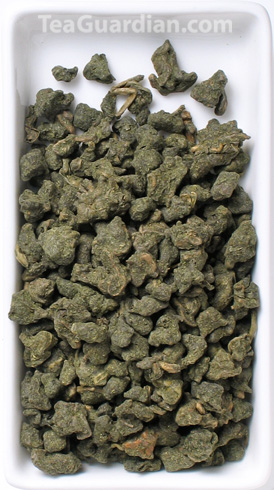
The popular “Ginseng Oolongs” are mostly low grade Anxi style oolongs coated with licorice powder, if not anything else that you don’t want to know…
Since the 1990’s certain bad influence has ignited the idea of flavouring lower quality oolongs here. One is marketed as Jingxuan with a “unique natural milk” flavour. It is the name of a cultivar yielding a low taste product that some makers further flavour it with condensed milk.
Another one that really is a big scam is the so-called “Ginseng oolong” (some are called “Lan Gui Ren”). Low grade Minnan style oolongs are soaked in a solution of licorice or coated with the powder. It would not be worth mentioning if it is just another flavoured tea like Earl Grey. However, very often questionable licorice materials and the hygiene conditions in which the tea is reprocessed are problems. There is also the concern of other additives. Together with the common issue of pesticide residues in lower grade Minnan oolongs, I really think this topic goes beyond the matter of fine taste and into the arena of public health. Public investigation or some sort of regulation should be in place. Such questionable qualities have made their way into the supermarkets in various fancy packagings, and into traditionally reliable teashops all over Asia and some in the West.
and now, the price
Another issue is the price. Sezhong varieties such as Huangjing Gui and Maoxie are a fraction the price of the highly priced Tieguanyin. I cannot disclose the real wholesale price here so I am illustrating the idea with proportional figures. Suppose a top quality Huangjing Gui goes for $100/kg, a top Tieguanyin can be $500 and higher. When you are beginning, do not go for such top grade. Most of the time, if you are not good in tea-making or if you are gulping it in any way, a $200 Tieguanyin already makes a lot of difference. Use it to develop your sensitivity and tea-making skills before you find the need to upgrade to better ones.
At the time of re-editing this post for re-constructing this site — about three and a half years after this article was initially published — the price of better tieguanyin has very dramatically come down, and the difference is not so big. Good quality is more affordable now. After over 15 year of being artificially inflated, the price of a tea has to be operable through the mechanics of the market after all. I hope the tea trade in China, or every other tea country, are learning something from this. The key thing is, tea is only one commodity that certain sharks in the financial world wouldn’t even brink if it dies. To some people, it does not matter if thousands or millions suffer if they can get one more digit in their bank account.
storage notes
One major attention for this category is the short shelf life (12). Traditional practice of giving thorough (and over) baking of the tea that ensures long shelf life has given way to the preference for the floral aromas, which will be killed by long exposure to heat. This direction of development is possible by the refrigerator. Minnan oolongs store much better in the fridge regardless if they are “vacuum packed”. For example, a Huangjin-gui’s normal shelf life of 6 months can be extended to one year or more when cold stored. That is why you can see refrigerators in some teashops nowadays.
The other concern is the popular practice of this so-called “vacuum pack”. One key element that affect the taste stability of Minnan oolongs is the residual enzymes and other bio-matters in the leaves that can still be active. Concealing it in a bag does not stop any possible further change. Low temperature, on the other hand, is much more effective, but beware that the plastic bag for this kind of packing is permeable to smell, so always double bag it before you put it in the fridge. <read more about storage>
Traditionally browned oolongs can be stored for maturity, but that applies only to those that are properly baked for the purpose. Please see the Tieguanyin chapter for reference.