Green Tea: Production
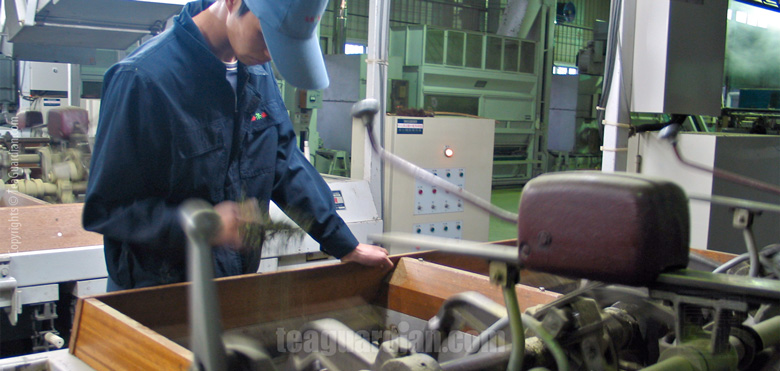
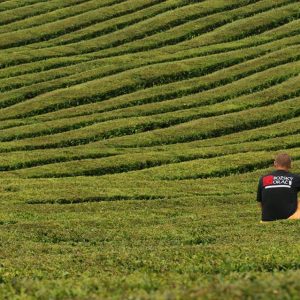
Green tea production: workman checking evenness of twist-forming of the steamed tealeaves in a production line in a tea factory in Zhejiang. In green tea production, there are large factories, medium factories such as this one, traditional family hand-work factories of various sizes and those that operate in a small house.
production styles
Variations in production processing styles and the use of cultivars, the simple principle of fixing the tea quite immediately after the leaf is plucked gives rise to thousands of varieties and qualities in the category of green tea. This is further multiplied by the natural changes in the biochemistry of a same plant when it adapts to the different growing environment in the wide-ranging producing regions today.
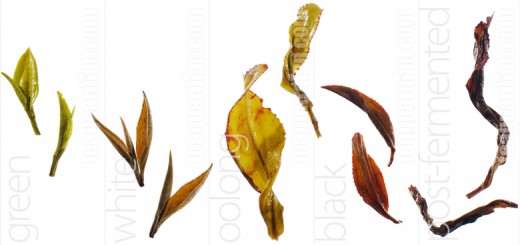
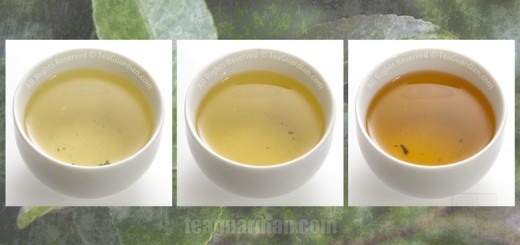
Contrary to common perception, not all green teas are green. Well, sort of. Some are so very pale that they appear white, some very dark that are almost black, some intensely green, some yellowish or grayish. The colour of the dried tealeaves is dependent on the nature of the original material, the production process, and the finishing process. It may also change when it is not properly stored and when it ages. The colour discrepancy between different selections of the same variety can be a clue to detect difference in quality, but not so for that between different varieties; i.e. a greener tea is not necessarily better than one that is not so green.
-

- Long’jing 龍井, a flat-roasted tea, is by far the most famous green tea of China. This one from Meijiawu, Hangzhou 杭州梅家塢 20528 | 8768

-
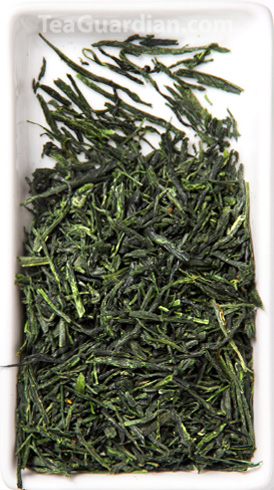
- Uji Gyokuro 宇治玉露 of a very fine quality “Purple Cloud” grade, a classic representation of premium Japanese steamed green tea.
-
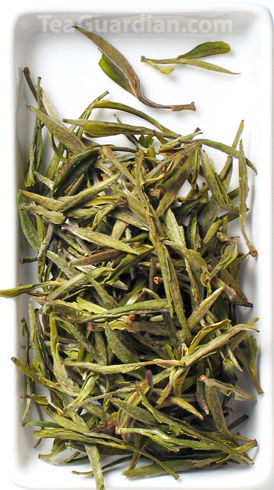
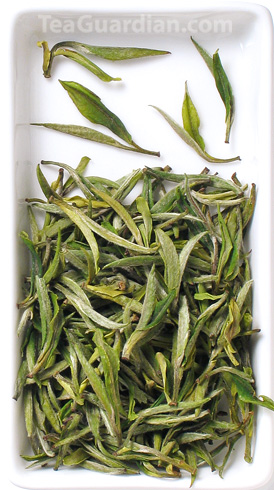
- Huangshan Maofeng 黄山毛峰, original style, premium quality. This is perhaps the most famous baked green tea. Notice that it is more yellow than some other green tea.
There are four major green tea production methods today:
- Air/sun-drying
- Steaming
- Baking
- Wok-roasting (referred to as cao qing in China, kamairicha in Japan, inappropriately translated as “frying” by some)
While a production may be made with one (or a combination of some) of the four ways listed above, it may also be styled in shape or natural-shape. Some air/sun-dried productions, and some baked ones are natural shape. Most others are styled. This gives us another way of categorization — by shape. I’ll list them here, although I think this is a most superficial way of categorization, and will not use it in this site.
Alternative categorization by shape (note):
- Round (Smooth needles),
- Downy needles,
- Curled and/or twisted,
- Twisted & straightened,
- Flattened,
- Beads (either tightly rolled leaves or really made into small spheres), and
- Orchids (retaining the natural form of the pluck standard of one or two young leaves with a shoot)
-
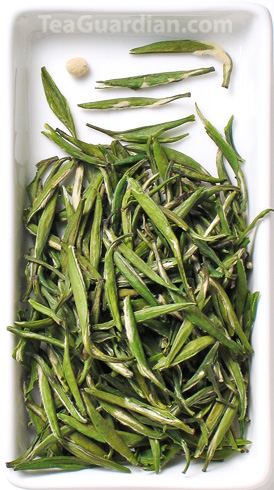
- Taimu Cuijian 太姥翠劍 A apical bud green tea from the national reserve Taimu Mountain area in Fujian. 20550 | 8800
-
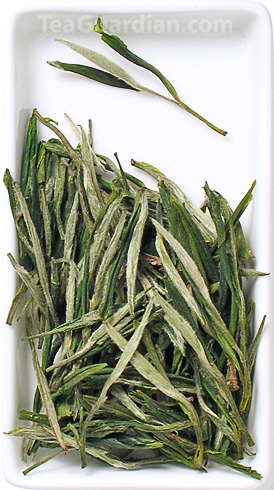
- Tianshan Yinya 天山銀芽 a rare green tea from the Taimushan-Tianshan region in Eastern Fujian. 20554 | 8833
-
- A green tea made from Taiwan wulong cultivars
-
- Luan Guapian 六安瓜片, one of the finest green tea varieties from the Anhui region
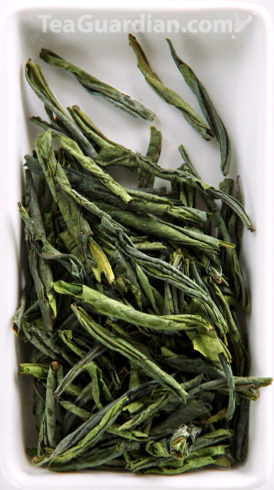
-
- Green Tea: Taiping Houkui 太平猴魁 This is a premium “bujian” class
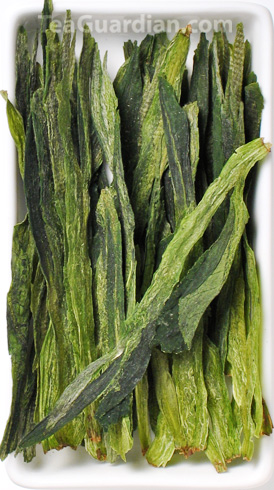
-
- Jasmine Silver Pearls, aka Honey Pearl Pekoe, Moli Xiao Longzhu 茉莉小龍珠, is a premium scented green tea. This one is a premium quality from Fujian
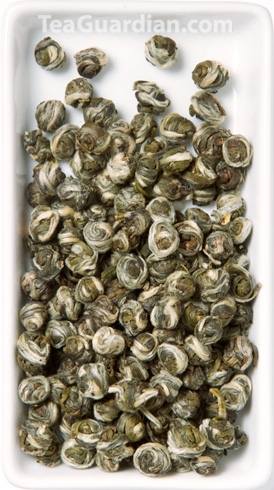
-
- Kaihua Longding 開化龍頂 An orchid shape bake-set green tea from Zhejiang 20531 | 8773
The 7 common styled forms in green tea production. From left to right, in the same order as the alternative categorization list.
Throughout the main producing regions for fine green teas, there are hundreds of major producers and thousands of smaller ones all trying to find marketing niches for their productions. A lot are quite similar. I’ll therefore, present only a few examples per sub-category in order to represent the array of varieties available. The selection criteria are quality, origin, character uniqueness, and accessibility of the genuine products. Omissions at this moment may also be a result of timing. The materials of this site will grow on a regular basis. The reader is welcome to register for regular updates of this site.