To blanch or not to blanch? That is the question
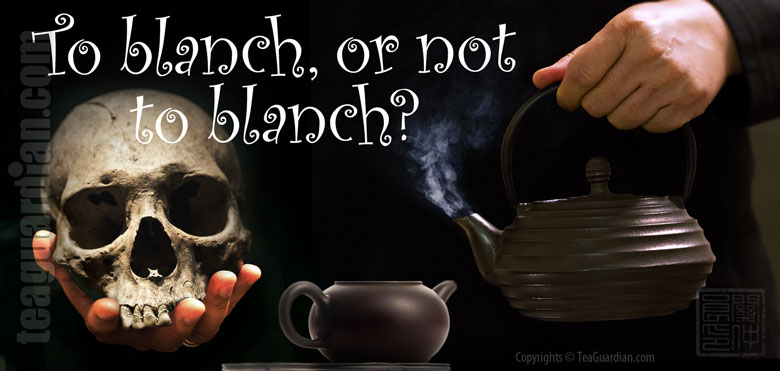
One of the perpetuating questions in tea infusion is to blanch or not to blanch — we look at it in a practical perspective and referencing the true qualities of tea to come up with a detail answer
When I was doing my graduate studies in Chicago, I had once a flatmate from India.
From the onset, he had been quite bitter that I was going to a better school while he had to start undergraduate in a lesser college all over again. He was particularly upset that for my Chinese ethnic origin I should have to begin with an English course but I needed not to. He had not been quiet about these issues for a good whole week. I thought it must have been his little period of cultural shock so I bore with it and tried to listen as much as possible as he laid out long stories of his past and his opinions about all things around here.
A Laughable Matter?
When for the first time he saw me blanching my tea before steeping, he remarked, “that is why Chinese is the biggest consumer of tea.” He came closer and chuckled, “You throw half away.”
It was a charcoal style Tieguanyin. He used only teabags and had never seen whole leaf tea before. He said tealeaves in India were all very small particles and not “raw material” like what I had. I tried to explain to him but gave up when he just kept mocking about the situation. He was happy to find something to laugh about in me and the culture where I came from. Otherwise he would argue until I got tired.
Indeed it would be funny to see a person blanch a teabag. Some think that the processing of discarding this “first infusion” is cultural.
Blanching not cultural, but gastronomic
Yet giving a quick wash to the tealeaves before infusion is very unlike the question of which end to crack an egg. It is not a matter of simple preference. It is rather a common sense in culinary science — some teas need to be blanched before their optimum taste profile can be achieved in an infusion. Although many who do it is simply doing it as a matter of habit, thinking of all the wrong reasons for it.
There maybe many other explanations of why the step is needed, some people will tell you, but if you look at tealeaves as an ingredient in cooking, the whole question is a lot easier to comprehend.

Not all teas are created equal. They are of different qualities, different nature. To prepare them well, these differences have to be understood and accordingly work with.
no two teas are the same
First and foremost, tea is not one singular entity. There are many types of teas, some hugely different from others in physical and chemical properties. Therefore, each will have to be understood as an individual ingredient. Some require us to blanch them, some don’t, some up to us. Others, such as fanning and broken grades, are simply too messy to blanch, not because they don’t need to, but because of their physical limitation.
Sometimes I don’t blanch too
One would think the most decisive factor for making the decision would be which tea variety the tea is. This is only half-correct.
Let’s take oolong as an example. When making Phoenix oolong of the bouquet style using the gongfu approach, I normally blanch it for clarity in taste and heightened aroma. I rarely do that with the most popular Phoenix oolong though — Honey Orchid ( aka Milan Xiang ). I much prefer to use the conventional infusion approach — big teapot and long steeping — to enjoy the maximum taste profile of this lovely tea.
The reasons to blanch
The real considerations to decide whether or not to blanch a tea are:
1. Surface structure of the leaf

Enlarged view of a cut of the tea leaf to show the structure
When the original cellular structure of the leaf is intact, it is more difficult for a balance of the taste and salutary substances in the inside of the leaf to infuse into the water. A thin layer of waxy structure, called the cuticle, naturally exists on the surface. Together with the hardy skin of the leaf — the epidermis — it protects the plant from losing water to the outside, and prevents water and other substance from the outside getting in. Pretty much like our skin.
1.1. Intact original surface demands blanching
Production of original white teas, such as Silver Needles and White Peonies, does not require much external physical force applying on the leaves. These varieties do have surface that is quite intact. It is even further hardened through dehydration. The downy hair in these teas gives them even further protection. That is why a good, thorough blanch to disarm the original surface protection is necessary before the actual infusion. Higher quality shengchas, which are mostly only very briefly curled, are similar.
1.2. Rolling, twisting, curling break leaf surface
The more rolling and twisting /curling the leaf undergoes, the more readily the dissoluble tea substances can be pulled out.
That is why broken and dusting grades that are typically used in teabags, cafeterias and other F&B operations infuse particularly readily, although the dissoluble matters on their minute surfaces may not be as desirable.
Different varieties and qualities of green teas differ dramatically. A high quality orchid shape green tea, such as Kaihua Longding, Huangshan Maofeng, etc undergo little curling so their surface structures are a lot more intact. On the other end of the spectrum, diligently rolled ones, such as Gyokuro, readily release the contents on contact with water.
1.3. Bio actions
The surfaces of dark teas, such as Pu’er and Lu’an, are not only seriously cracked through rolling, but also by the penetrative action of the enzymes and tentacles of the microbes that cause the tea’s post-fermentation. Although these teas generally infuse a lot more readily, yet do require blanching for reasons listed otherwise as in another paragraph below.
1.4. Compactness of the tealeaves
Those varieties which leaves that are formed into tighter mass also require blanching to crack the surface of this artificial structure. Compressed teas, such as tuo cha, cha bing, and other tea bricks, even after you have broken a chunk from a larger mass, need to be blanched more than once. Beaded teas, such as Jasmine Pearls ( aka Dragon Pearls ); and half beaded teas, such as Tieguanyin, fare also much better after heat and water have loosened the mechanically tightened surface.
2. Nature of dissoluble matters on leaf surface
One common reason for many consumer to blanch the tealeaves before steeping their tea is their belief that they are able to wash away the dirt on the leaves. That is why in some language the blanching process is called to wash the tea.
2.1 Dirt
One of the teas that has most surface dirt is probably the category of post-fermented teas. The leaves are piled in huge piles for months to allow microbes to grow on them to cause the desired fermentation effect. In the old days when such process was done “naturally” ( read: in uncontrolled environments ) the amount of alien matters on the leaf surface can be imagined. All the more when you consider the poor packaging of those days and that a huge proportion of the tea category was sold to nomads who carry the compressed chunks of leaves cross terrains and weathers.
In actual experience, ridding the leaf surface of the remains of microbes and dust collected through the lengthy piled processing is critical in revealing the true taste profiles of all post-fermented teas. In this capacity, the step of blanching is correctly referred to as washing.
2.2 Crust of aging
Matured teas, whether dark teas, white teas, shengchas, oolongs or black teas, do benefit from this wash. Oxidation, dust of the leaves themselves eroded through time, and often the unavoidable yet invisible growth of microbes all contribute to possible palatial sensations that are not necessarily contributive to a good taste profile. A good wash helps. In the case of matured white teas, shengchas and dark teas, I often encourage blanching the leaves two times.
Other teas in poor packaging and handling environment, even green teas, are likely to have gathered a proportion of alien matters on the surface, mostly dust, also benefit from the cleaning step.
Although broken grades, dustings and fannings of any tea categories are even more in need of such a wash for the same reason, their particles are too small for the step to be convenient. However, if you are in a situation when you have to use such qualities, do consider putting a bit more of the particles in the infuser or doubling the teabags to very quickly blanch them for a cleaner tasting cup of tea. As I wrote this, I had a chill of my ex-flatmate from South Asia disagreeing and delivering huge speeches had he read this.
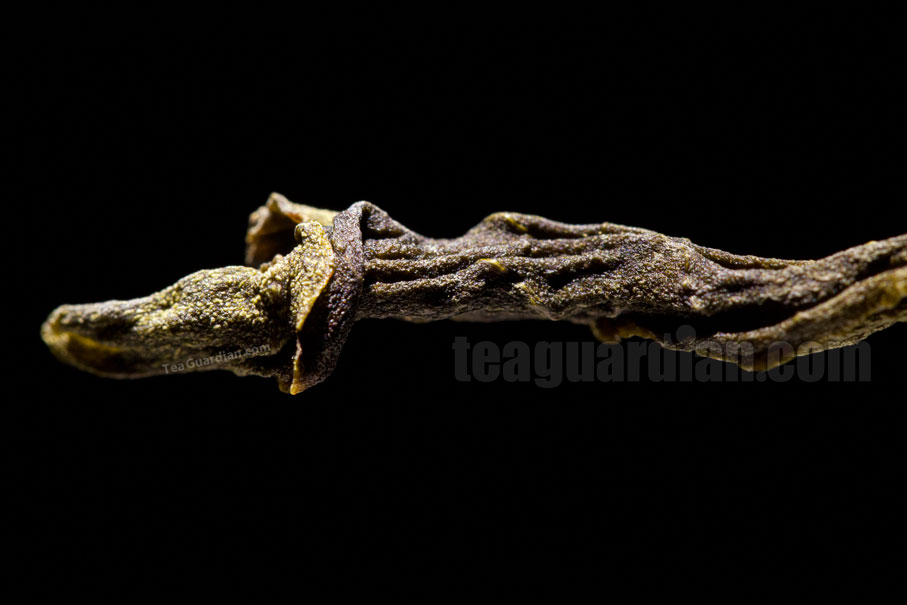
Deposits of solidified soluble tea substances line the surface of the dry oolong leaf. The tea sample used in this photograph is Lanhua Xiang Dancong — aka Orchid Gratus
2.3 Tea Juice
Dust and debris are only one kind of the surface substances when considering whether to blanch a tea or not. The tea “juice” that came out onto the surface of the leaf during rolling and curling, and then dried and stays on is another.
This “juice” is a cocktail of quite a few things: carbohydrates, polyphenols, caffeine, to name a few. Some crystallise, some got heat reduced, and over time, some got oxidised. This “crust” varies in composition and proportion from variety to variety, quality to quality. In some teas, it is better to count them in the liquor, while in other teas, reducing the presence of its components could improve either the taste or the ratio of health related substances.
For example, a deeply baked traditional style Wuyi oolong would taste a lot cleaner and smoother only after a good blanching to rid the coating of carbonised carbohydrates — char, like the blackened crust of your BBQ sweet pepper. On the other hand, a good quality black tea such as Red Plum Classic or the Taiwan Red Jade taste so much richer when only the infusion vessel is well preheated and the tealeaves infused straight away. That is because the moderate baking in the last stages of the processing caramelises the tea juice that was forced on the surface of the leaf during processing.
2.4 Moderating the amount of caffeine in the liquor for oolongs
Caffeine is readily soluble in very hot water. In a study in Auburn University in Alabama, USA, researchers discovered that on steeping 3.5 g of oolongs for 30 seconds, 60 to 70 mg came into the water, while the subsequent infusion obtained only 19 to 21 mg of the substance. (note) That means in the first contact of hot water about three times the caffeine can be infused compared to the subsequent infusion.
The study was done on half beaded style Taiwan oolongs. I guess if it were to be traditional “twiggy” leaf type oolongs, a higher percentage of the caffeine would have dissolved in the first round. All Wuyi or Phoenix aficionados know that when using the gongfu infusion approach, the first steeping is the strongest in caffeine. It is theorised that somehow more of it crystallises on the surface of the leaf in the particular processing in oolong production.
What it means really is if you want a good kick, do not blanch your oolong leaves and use a lot of it to infuse for 30 sec. If you want to avoid too much caffeine, give the leaves a good, long wash; but maybe not as long as 30 seconds. A short wash will be moderation.
I am not sure if the same can be said of other tea categories, since we have not been able to find more studies on the topic.
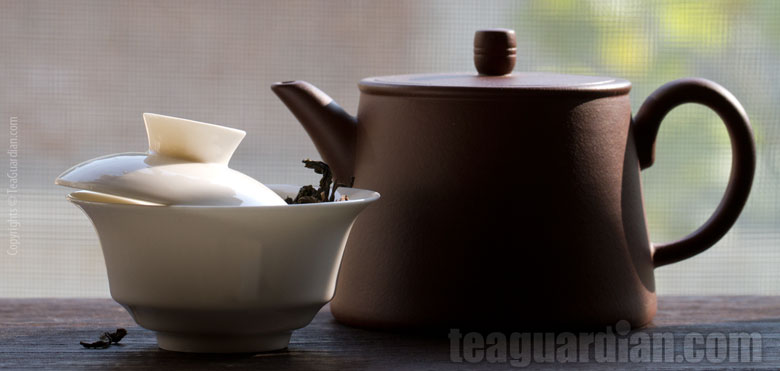
Different infusion tools and environment demand difference in the infusion approach
3. Infusion approach and conditions
The process of blanching does not only open up the leaves for effective infusion, but also warms up the infusion vessel.
Therefore, it is more desirable for shorter infusion duration, such as a 30-second one or shorter to have the leaves well-blanched prior.
When the infusion vessel is not pre-heated well enough, or when one is simply too lazy to preheat it, or in colder conditions, the step brings the whole internal environment of the vessel to a better temperature for a more desirable infusion condition.
On the other hand, when a tea that you think should not be blanched lest all the good stuff wasted, preheat well the vessel to do the job.
Very broken leaves, dusting etc, which although may benefit from a good wash, cannot be easily executed unless the debris is contained in a fine mesh infuser. As always, I do not recommend teabag type of infusion envelops unless you are very sure that the heat from the water is not drawing any harmful substances. Though my long-ago flatmate had been using it all his life, it does not mean that it is a good and safe way.