Teaware: The Incredible Chahai
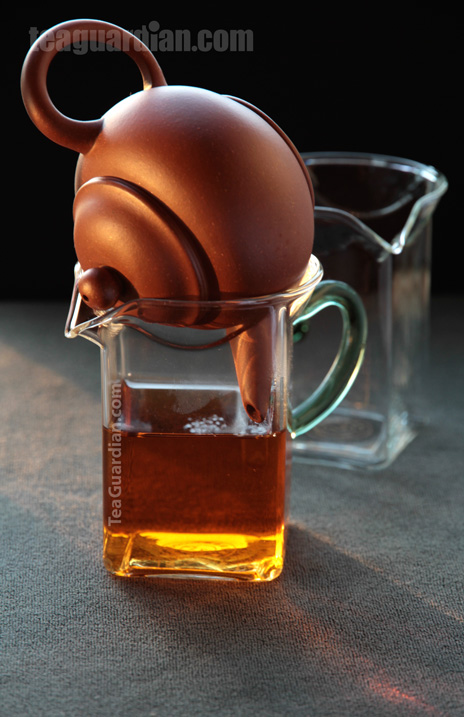
Draining well the teapot of each infusion is easily done with a chahai with a special bowl shape opening where the pot can sit. Glass chaihai with handle made in Fujian. Yixing teapot in the “Shuiping Hu” design made from matured clay. Tea prepared from Bailin Xiaozhong Gongfu at BS tasting standard.
When Lu Yu wrote the Tea Classic (Chajing) a millennium ago, he probably would not have imagined how the tea preparation centre piece, the tea bowl, has dramatically become a gaiwan or a teapot today. Tea drinking has ingrained into the human culture as dramatically as the material of tea itself has evolved through generations of development in production processes.
Sea of Tea
One tool often seen in the tea connoisseurs’ tea table today is a little lidless pot into which tea is decanted before pouring into the cups. Chahai, literally “sea of tea”, would be a strange name for a tea tool to Tang dynasty Lu Yu.
So was it to any avid tea drinkers even a couple of decades ago in the gongfu tea capital, Chaozhou, where tens of thousand of chahai’s are now produced each day. To old-time tea tongues, chahai was a name used to refer to a different tool with a different purpose altogether (we’ll cover that in another article). The tool which sometimes is named in English as “decanter” or “intermediate pot” or “tea jug”, or whatever the translation, was not needed in those days. The tool’s capability of evening out the strength of the liquor from a round of infusion was covered by a special step in the gongfu tea preparation process that is rarely practiced today. “Guang-gong xun cheng” (more about it in another article), as that step is called, has never been easily practiced well. The strength of the tea in different cups had scarcely been similar unless served by an old hand in the practice.
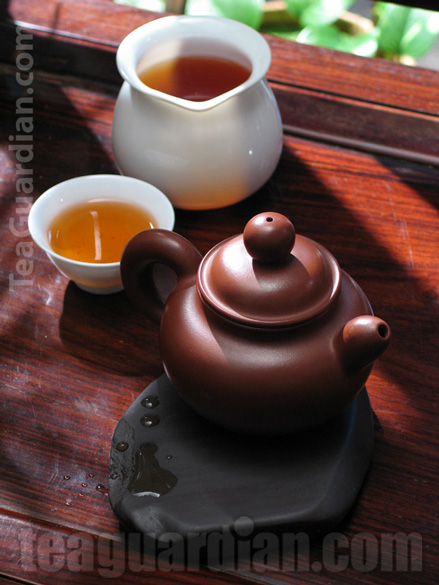
Handle-less white porcelain chahai with dish shape opening design for easy holding as well as for resting the teapot for complete draining. Kaolin porcelain chahai and cup made in Guangdong. Yixing teapot with oversize lid bead made by He Yan Ping with fine matured clay. Tea prepared from matured charcoal style Tieguanyin in gongfu preparation approach.
Uneven concentration in the tea liquor
As the water surrounding the tealeaves got infused with the substances from them, it gets denser and sits at the bottom of the teapot or gaiwan, but it is the paler infusion above that pours out first. The strength of the liquor received by the first teacup is lighter than that of the second teacup. With a tea that infuses quite readily, such as a golden tip puer, the difference can be very dramatic. The taste of the tea, or the quality of infusion, as experienced by the person using the first teacup would be quite different from that using the second one. The issue exists whether you are using gongfu tea preparation or steeping tea in a big pot.
That’s before chahai, or the concept of it, was created. As to who and where it began, no reliable records can be found. The idea of creating a tool to even out the strength of the infusion before serving up in the cup spread so rapidly that there are hundreds of designs popularly available now and, for its relatively new arrival, it has already become an indispensable tool on the infusion tray. However, all that in the market are those 200 ml capacity specifically for small portion style, what about those who drink tea by the “normal” size cups?
Improvisation
When my extended family meet up for dimsum in a restaurant, which happens quite regularly, one of my sisters would always ask for additional empty teapots for the purpose. When the tea (I bring the tealeaves, naturally) is steeped enough in the normal dimsum restaurant teapot, it is poured into the empty pot to put on the lazy susan so the army of critters around the largest table(s) available in the restaurant can be filling their cups to wash down the greasy morsels while busy with whatever chats, games, jokes or speeches.
It is the concept of evening out the tea and not letting it soaking the leaves that matters. Any containers that decant may work. It is rather the inertia of not updating old concepts that is not improving one’s experience with tea.