Teaware: The Gaiwan
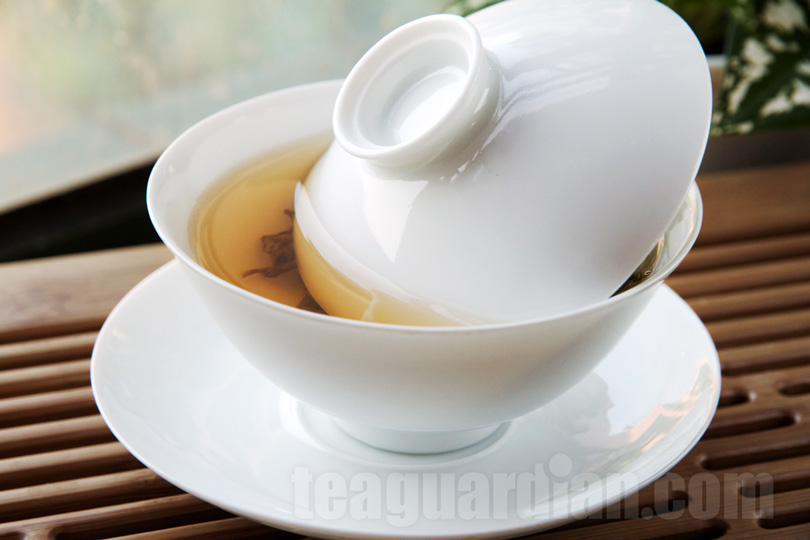
Bowl-shape gaiwan, hand-thrown kaolin with white over-glaze. Tea: Xingren Xiang Dancong, a classic style Phoenix oolong.
The Gaiwan (gài-wǎn, literally lid bowl) is perhaps the most versatile piece of teaware. It can be used as a teapot, a taster’s mug, or in place of a tea cup. The optimum material for it is porcelain. They come in various designs and a huge range in prices, from very affordable mass-produced ones to one-of-a-kind artist pieces. It might have been invented as a tea tool in the 9th century but the present-day form got popular only after the 18th century.

Decanting from the gaiwan into the chahai: a decanter in which the strength of tea is homogenized. That is why it is also called “the make-fair cup”.
Using a Gaiwan
Because of its simple shape with a wide opening and no undercuts in the interior, the gaiwan is easy to clean and slick to use, once you get used to it. When it holds a small amount of leaves as in conventional tea making approaches, the wide, inverted bell shape facilitates convection of the water inside for optimal infusion effects. Better yet, its openness enables it to hold large amount of leaves, even bulky ones, easily so that those prefer the gongfu approach have it as a staple tool.
Choosing a Gaiwan: Sizes and Shapes
There are quite a range of sizes and shapes. My recommendation is based on functionality and versatility. Disregard my opinion if you want to buy them for fun or collection purposes.
The ergonomics and heat physics of the shape is considered for how the ware can be used both as an effective tea infusion tool as well as a cup to drink from. In addition to the choice of material, there are five main considerations:
-

- Lid: Not only is the lid instrumental for infusion quality and ease of handling, it is also decisive to the look of the gaiwan. The dome has to rise high enough for proper insulation for the surface of the tea liquid, yet low enough for the fingers to manoeuvre on it with comfort. The rim has to be thin enough for precision in scooping the leaves, tea foam etc, and yet not too thin to be easily breakable. The button, which is critical for handling whether using the gaiwan as an infusion tool or as a cup, has to be raised high enough from the lid to avoid too much heat conducted to it. To that ends, thinness of the material is also critical.

-
- Tea Bowl: The shape, thickness distribution and material integrity of the tea bowl is the soul of a gaiwan. The manner with which heat is circulated, dissipated and maintained inside of it is key to infusion quality. Proper thinness and curvature at the brim, a wide enough belly to allow scooping by the lid and a balance of weight are key to smooth handling.

-
- Tuo: The tuo of a gaiwan serves both the purpose of a saucer and that of a cup ear. It has to have a receiving cavity to fit the foot and bottom of the bowl nicely so that when the bowl is tilted for drinking, it is still securely held between this cavity and the lid that is pushed back, held by the other hand. Other names for the tuo include receptacle, saucer, tea bowl stand, etc. For more info about how to use a gaiwan as a cup, please read this article: Using the Gaiwan as a Cup

Height-Width Ratio
The ratio determines how easy it is for the lid to turn the ball of tealeaves gathered towards the bottom of the gaiwan. The height of the bowl itself should be at most two-thirds of the diameter of the lid when one intends to use it in gongfu tea-making.
Bowl Shape
The tapering of the bowl should be such that the ball of tealeaves can be easily gathered at the bottom for turning and cleaning. The bottom can be angled or round. The tapering also facilitates flow of liquid during decanting or drinking.
Lid Shape
The button of the lid should concave in the centre such that it can be an effective heat dissipater rather than a heat reservoir, or you burn your finger. The dome of the lid should be slight, but not flat, such that enough air is trapped between the liquid and the lid as an insulation layer. Over doming makes it difficult to handle when you need to press the lid down during decanting.
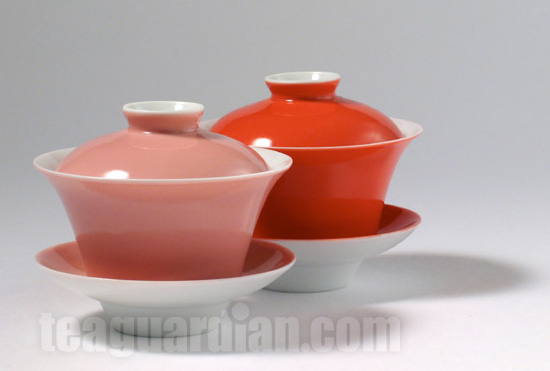
140 ml gaiwans, porcelain with colour overglazes. This is the standard, and well-proven, shape of gaiwan for gongfu tea-making. Great as a cup as well.
Saucer Shape
The saucer doubles as the handle when the ware is used as a cup. Therefore, the bowl has to be able to sit comfortably and securely in it so that when the hand lifts the saucer there is little rattling of the bowl inside the saucer. Such that it feels safe when the hand tilt the saucer to tilt the bowl for drinking. Therefore, the depth and shape of the concave in the centre is critical. The width of the ring determines how easy it is to lift the bowl by holding it. Too small, the bowl becomes heavy and clumsy to handle; too wide, the saucer hits the chin.
The size of the user’s hand and how comfortable she is able to control the ware is another major consideration. Your confidence of the tool determines the quality of your infusion, as in cooking.
Material thickness

Tall gaiwan with blue glaze. A tall shape is best for use as a cup and for infusing green or black teas employing longer infusion time. This particular design has a ring saucer, an homage to the structure when it was invented, probably in the 9th century
The size is considered together with heat dissipation quality for the ware’s optimum infusion capability. For mould-made gaiwans, which I use normally for economics, I usually go for those with an average thickness of 1.5 mm (side walls of the bowl) and capacity of 140 ml. That is good because the infusion duration I use with these gaiwans is usually between 20 seconds to 3 minutes.
If you use longer infusion time, use a larger, or a thicker one.
I have not done any scientific calculations and recorded experiments with it, but when the thickness goes up to around 2 to 2.5 mm, the heat holds a lot longer. However, the material becomes a bit too hot to handle with ease, and pouring becomes much more clumsy.