Making Tea with the Mug
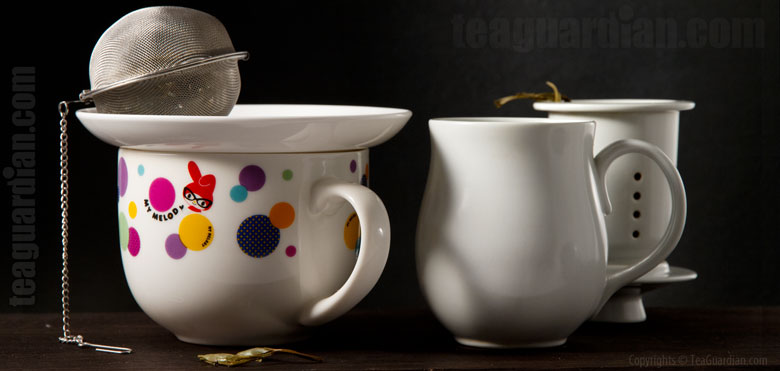
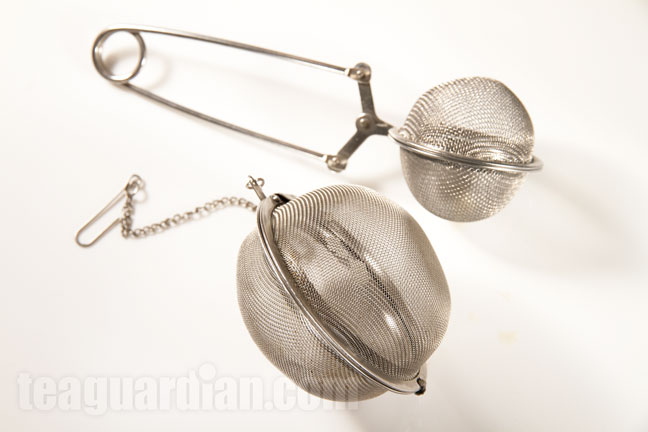
Tea infusion with the mug — left: a mug with a make-shift lid that is a saucer, using a stainless ball shape infuser; right: a specialist tea infuser mug with a deep infuser.
Using the same container both to make tea in and drink from is the most popular, and easiest way to have a cup of tea. The gaiwan has been in popular use for a few centuries now but it may not be a suitable piece for some people. Many prefer a mug.
An Infuser Mug
A mug with a built-in infuser is designed such that the user can take out the leaves easily when enough steeping is done. The infuser mug may not be the equipment to bring out the best in a tea, but it certainly is very convenient. It would be ideal if you have one, but if you don’t an add-on infuser may do the job too.
The Mug
A mug for better infusion results should have a good size belly, which thickness should be even and taper gradually towards the bream. I recommend at least 250ml capacity, though I myself often use those that are 350 to 500.
To give your mug infusion capability, get an infuser. Select one that is as large as your mug can possibly hold.
The Infuser
A large and deep infuser designed with the mug is a great choice. If you can afford to get an infuser mug as such, make sure you get one made in nice, thick and even porcelain or glazed stoneware.
If, however, you want to hold on to your old mug, you may consider buying an infuser to use with it. Choose the largest size possible that fits your mug, so the tealeaves can freely expand and ample water convection can take place. Traditional “English” designs of little metal balls or lidded spoons are NOT good designs; they are meant only for infusion using a bit of broken leaves.
Make sure you have a good porcelain or glass lid. Metal ones let heat transmit too quickly so they are bad for your infusion results, and you may not want them to scorch your fingers.
Infusion tips
Since this is a convenient tool, and most people don’t have the time and luxury to control the hot water supply, I’ll discuss its use in two directions: one with controllable heating, the other without.
Without Controllable Water Heating
The most common heated water supply in a workplace would be one of these:
- The hot water outlet of a drinking fountain
- The hot water pot of a coffee heat plate
- The hot water outlet of a coffee machine
- The hot water outlet of a water boiler
In most cases, the temperature of A and B would be between 55 ~ 75°C, while that in C and D could be 90 ~ 95°C or above.
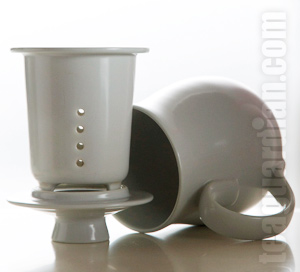
A specialist grade tea infuser mug, with a deep infuser and round belly for optimised infusion result. Matte celadon glaze stoneware.
Water sources with lower temperature
For those with access to the former two lower temperature sources, maybe the best policy is to choose teas that would have acceptable infusion results even at these low temperatures, such as most green teas.
If you insist to have oolongs, choose classic or browned style ones, smash half of the leaves so the content can come into water a bit more readily. If your infuser has bigger holes, sandwich the broken leaves between two layers of whole leaves inside the infuser. The same with black teas. It is advisable to smash the leaves only immediately before infusion to minimize oxidation through exposing to air that will degenerate the tea quality.
When you have lower than needed temperature, it is more important for you to preheat your mug. A swirl of hot water already makes a difference. Conditions allowing, blanch your leaves before the actual infusion.
You may also consider increasing the leaf ratio and make two blanching before infusion to see if the combined conditions of your tea, the water temperature and your mug together would deliver a better result.
Water sources with higher ( or too hot ) temperature
For those with access to the latter two water sources that are higher temperature than you need, you may:
- Use the top drop technique for teas requiring lower temperatures
- Use the sandwich technique for teas requiring medium temperatures
- Choose teas requiring higher temperatures and blanch the leaves properly before infusion
- Get a separate water jug to let the water cool to the required temperature
If you really do not have much time to attend to all the details, the simplest way for a better mug of tea in such condition is to use a lesser leaf ratio, submerge the infuser with leaves in it AFTER hot water is filled in the mug ( leaving space for the infuser ), cover and let it stand for a longer infusion time, say 7 min. This will give you a satisfactory result for even some delicate green teas, but not pu’er, shengcha or white tea. They need proper blanching.
With Controllable Water Heating
- Preheat the mug and the infuser with the heated water at the required temperature
- Put in the desired amount of leaves in the infuser and put the infuser into the mug
- Blanching the leaves with water at the required temperature is optional but if you use any of the following varieties, blanching is highly recommended: post-fermented teas, shengcha, matured oolongs, or other matured teas
- Fill the mug up to 1~2 cm below the rim with the infuser in it with water at the required temperature
- Cover the lid and let steep for the required amount of time. On this note, proper temperature allows you to use a higher leaf ratio for shorter infusion time and lower leaf ratio for longer depending on your taste preference and infusion habit. That is to say, either conventional or gongfu approach can be conducted inside a mug provided that you have the control for the right temperature.
- Remove the infuser, drain and let the liquor cool until drinkable. Enjoy the aroma meanwhile
- Sip slowly but do not drink when the tea has already gone cold
Real tea can be nice and quick and easy at the same time.