Gongfu Infusion: Chapter 2
Understand your tea before you devise an infusion plan

Decanting from the gaiwan into the chahai: a decanter in which the strength of tea is homogenized. That is why it is also called “the make-fair cup”.
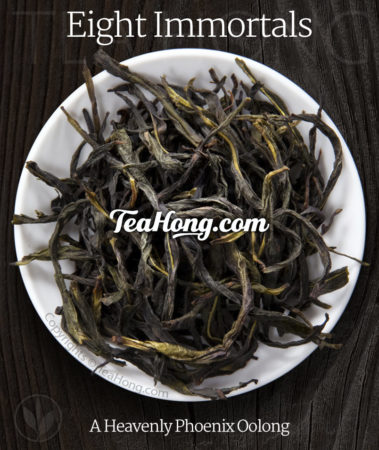
I shall not repeat myself in the steps of gongfu infusion that you can find in chapter 1, but go into particulars of how I prepare this particular oolong to maximize its gastronomic potential.
There are a few things in my consideration:
All traditional Phoenix oolongs are produced from cultivars of more ancient heritage and therefore more bitter than teas from newer cultivars. Finer ones from higher altitudes, although with higher contents of EC and EGC (epicatechin and epigallocatechin, which give sweet aftertaste), they are also higher in EGCG, the bitter yet most potent health contributing polyphenol in tea.
I also cannot soak the leaves in water for too long, because all the precious essential oils would have evapourated onto the underside of the teapot (or gaiwan) lid, oxidized and wasted.
The tea cannot be decanted too soon either, I need enough tea substances for a balanced and full body, as well as the slow dissolving pectin for weight and silkiness in the liquor.
To minimize my infusion time to avoid excessive bitter catechins and yet enough other things, I have to use ample leaves.
I also have to give ample heat for partial of the leaf volume to extract the substances more readily, and not so high for the rest so those that take longer time, but not temperature, to infuse can have the time while avoiding too much high temperature-facilitated infusion of EGCG.
Core idea of how I control the infusion
So I am skipping the pre-warming of the gaiwan but heat it up while pouring water for the blanching step — the stream of water from my kettle goes around the inner surface of the gaiwan. This way the maximum heat from the water dissipates into the bowl and the leaves immediately next to it. The water that reaches the core of the “ball” of tealeaves is thereby much cooler, relatively.
For people whose palate is quite new to tea, 20 seconds is good enough for the first round of infusion. As for myself, I think a full body wouldn’t come by until 30 seconds. Again, don’t be confused by those salespeople in Chinese teashops who keep water in the gaiwan for 5 or 10 seconds. Most such people do not really know much about the things they are selling.
In order to maintain a minimum infusion time, adjust the tealeaves amount. I do 6g myself, because I like some strength in this tea. Use 5 or even 4 if you prefer a softer body.
90°C water is good to bring out the floral-fruity aroma and optimal sharpness of the tea. If you are not using this tea but some other Phoenix, this temperature may not be the best. For example, a relatively deeper baked, honey-sweet Milan Xiang or the like would ask for a lower temperature.
Readers have asked about whether it should be the temperature of the water before it touches the leaves, or after, or the temperature in the vessel during infusion. That’s actually a very important question. How water changes temperature between the very brief moments of before, during and after contact is quite critical in the infusion quality. Before we go deeper into this in further chapter, let’s think of it as the average temperature immediately after the water is in the gaiwan.
enjoying the aroma
When you are only preparing tea for yourself or a very close drinking partner, share the chahai after tea has been decanted from it into the cups. The heat and the thin film of tea on the wall of the small decanter continue to generate the pacifying bouquet aroma of the tea to pipe through the vessel.
The Taiwanese invented an extra piece of teaware, “wenxiang bei” (cup for fragrance sniffing) for the purpose. Tea is decanted from the chahai into this tall intermediate cups before each drinker in turn pours the tea from these wenxiang bei into their own drinking cups. Each has his/her own mini chahai to smell from. Only that because of so many pouring, the heat is quite lost. To use the wenxiang bei well, it has to be pre-warmed amply before tea touches it.
For floral aroma tea I prefer the use of taller drinking cups, such as this magnolia cup, and skip the wenxiang bei thing. To me, it is a bit too many steps for the simple pleasure of tea. I think the tall cup takes care of the purpose very well.
The core of the whole experience is drinking the tea. While the tea is still hot, I’d take the opportunity to soak my nose in the fragrance. Not too close though, else your own breathe would be blown into the cup and ruin the whole thing.
Drinking
As the tea cools down enough (but not too much) to drink, I’d swallow the 50ml in 3 sips. I don’t do the tasting kind of slurping to draw air and make a lot of noise in daily life, unless I want to make a clown of myself to please my loved ones. I’d rather let the liquor swim through the gaps of my teeth and above and below my tongue, left to right, front to back, before letting it go behind my larynx and through the throat. Most of the time I’d let the tea soak my throat a while to feel the taste there, before I do the next sip, or next cup.
While I am preparing for the next round, I continue to feel the tea’s work in my stomach and on the back of my head behind my ears.
The process of enjoyment is a part of gongfu tea infusion.
This maintaining of a ball of tealeaves is kept until the outer most leaves are quite used up into the fourth or fifth round of infusion. At this time, it can be turned inside out for better extraction.
To finish up, discard the leaves into a sieve so as to drain them. Cleanup with a good wash of boiling water and basically you do not need detergent at all. Stay eco-friendly.