Modified Teas: Scenting
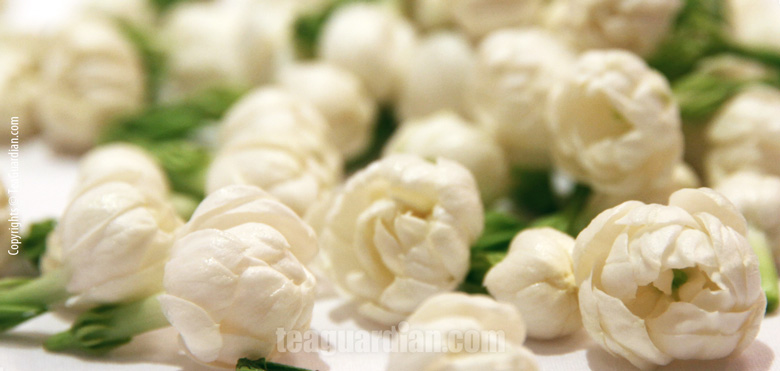
Tea has been popularly consumed with various other ingredients since antiquity. Milks, nuts, grains, herbs, spices, salt, sugar, etc have been used to add scents, flavours and textures to the drink in various places in China. It was not until the 8th century that pure tea was hailed as the ideal and made imperially official. One likely reason for that was better teas were possible through improved cultivation and production methods after centuries of using the plants. When the drink’s own flavour is likeable, adding things to disguise them became unnecessary.
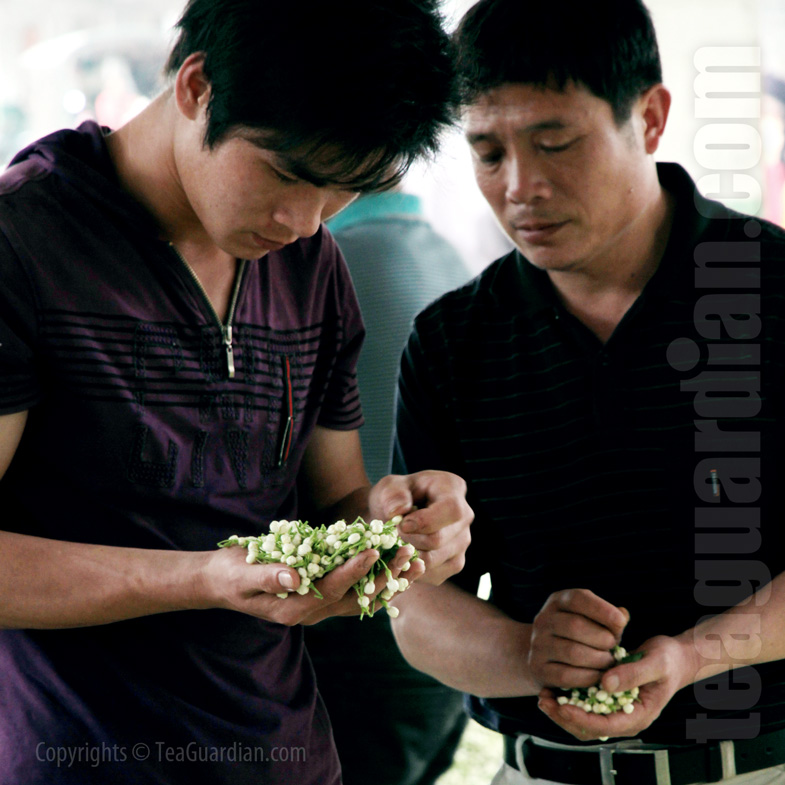
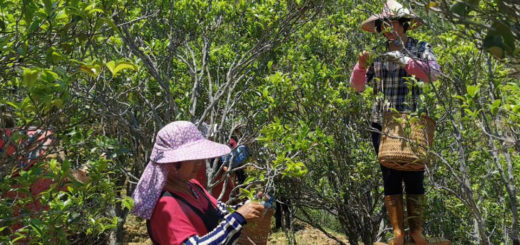
Scenting artisans examining quality of the current harvest of jasmine flowers. Hengxian Jasmine Market, Guangxi
adding charm to a tea
Nevertheless, one style of flavouring the tea continued to develop amongst mainstream tea drinking, and have become an influential tea category for fine and mass market tea alike: scented teas.
I shall focus in this article about this category and discuss how scenting in fine teas has been done in the traditional way. Other ways of scenting, such as spraying with extracts or chemicals, or mixing flowers or flower parts in the tealeaves, are practiced in mass market products or in imitation fine teas. So are flavouring in teas. I shall not discuss them here.
Scenting: Basic concept
A flower releases its aromatic substances as it blooms. Tea, when dried, is a powerful absorption agent (that’s why they have to be properly stored in order not to absorb unwanted odours). Therefore, when tea is put next to blooming flowers, it takes up the fragrant essence of the flowers. The sweet natural aroma of flowers thus pairs up with the purifying taste of tea to become the appeal of a scented tea.
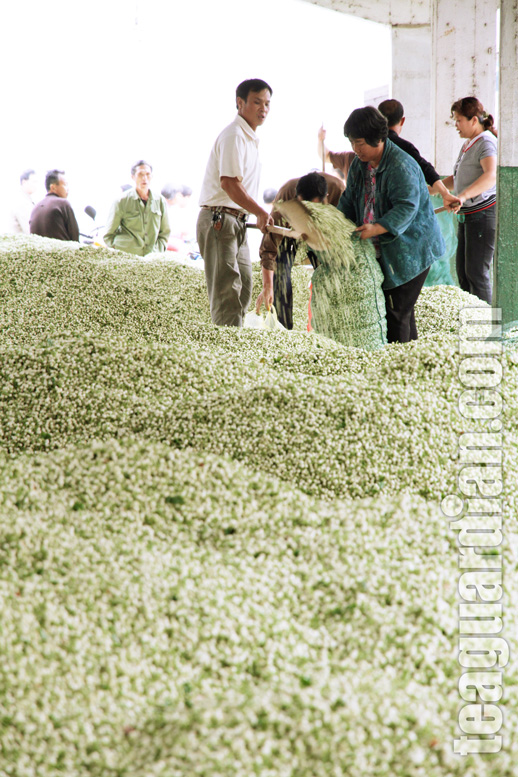
Mounts of jasmine flowers in the jasmine market in Hengxian, Guangxi
Scented tea has been extremely popular around Yangtze delta and north of it, where greasy or meat biased diets have been predominant. People have the intrinsic need for cleansing. I guess that is also why some people in the West very naturally fall for its appeal. I have to stress here however, that scented teas are not any better than other tea categories in the cleansing sensation or functionality. It is only the dominant aroma that attracts more easily.
Flowers
The technique of scenting tea with camphor and flowers was documented in a popular cookbook (1) in the 13th century, and extended mentioning in key tea books in subsequent eras. Nevertheless, some of the flowers that were used then are still popularly used now. That include jasmine, rose, osmanthus (2), tangerine, gardenia, chulan (3), mì-lan (4), champaca (5), and michelia figo (6), etc.
Some of these flowers are used alone. Some are used as accents in certain productions. For example, jasmine scenting is very often aided with white champaca for the more pungent effect and reduced labour and material costs. Using purely jasmine is restricted to very fine productions in the hands of experienced and skillful masters.
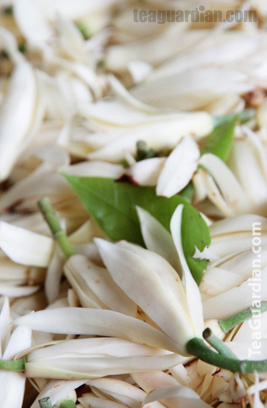
Michelia alba, known to the local Chinese as Bai’lan, is popularly used to give ascent to the scenting. When I was a small boy, older ladies used to put a couple of it on their loose blouses in place of perfume in summer.
Cha pei (tea foundation)
Baked green teas, black teas, and oolongs are three most popular tea categories used for scenting. There are occasional roasted green and dark teas too. The choice of tea is dependent on whether the natural aroma of the tea would work well with that of the desired flower. Certain lower fire baked green teas are naturally low in aroma and mild in taste, so they do not crash with most flowers. That maybe why this is by far the most used cha pei for natural tea scenting.
Very often I see in some commercial literature or website saying that white teas are used for scenting. The fact is, white looking GREEN teas are used instead. White teas are not used because their own taste characters are quite unique yet mild and would easily crash with the scents of most flowers. Moreover, genuine white teas are dull-looking enough already because of the slow oxidation they underwent during processing — scenting and repeated re-baking would further reduce their look.
However, certain teas with stronger characters can work really well when a right flower is matched, such as a Phoenix oolong with osmanthus, or a Fujian black with rose. In Guangdong, they even first put the juice of the sweet lizhi fruit (aka lychee) in their popular Yingde black before scenting it with rose.
The scenting process
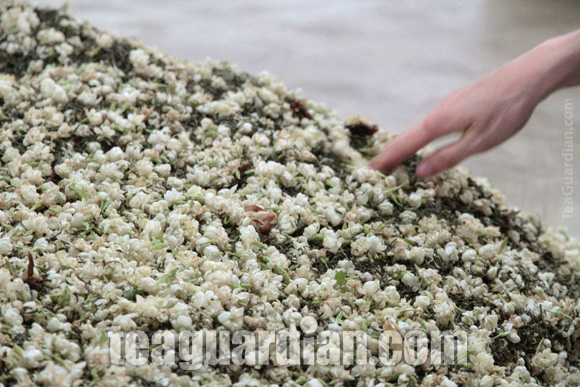
It is quite hot when you stick the hand into the pile of tealeaves with blooming flowers. The bio-heat can hasten the blooming and absorption of the fragrance, but it can turn the plant materials bad as well. Timing to re-pile and separating the flowers takes a good understanding of the process and the nature of the different leaves to be scented.
Ready to bloom flower buds are collected on the same day as the plucking for immediate use. Some tea producers call this buds “hua mu” — the mother of the flower scent.
In scenting a green tea with jasmine, a layer of tea, about 1.5 cm thick, is laid on a plastic matt on the floor. A thin layer of flower buds is spread on top of it. Another layer of tea goes on top. This sandwiching is repeated for a few layers to about 30 ~ 45 cm thick, depending on the quality grade. The biological heat of the flowers trapped by the tea layers hastens the flowers to bloom. The tea absorbs the released fragrance.
In finer teas, this scenting process is repeated a few times, each time using fresh flowers and the used ones removed. The tea has to be bake-dried each time. In very fine ones, there can be as many as 6 rounds of that plus an additional half-round of scenting only.
Scenting with rose is a bit simpler where the flowers are just mixed in the tea. It used to be mostly black teas, but lately there seems to be some people scenting also green teas and pu-ers with the flower. Anyway, the mix is piled up to about 40 cm for a one round scenting. The flowers are removed before the tea is put through drying. A sprinkle of dried rose petals is added on later sparingly so taste is not sacrificed for decoration. This is not to be confused with other products that are mixed with petals without the scenting, or with spray-on scenting.
Scenting long-twist oolongs with the tiny little flowers of osmanthus is a little tricky. Heat has to be used to force the buds to bloom because the loose tea, unlike greens, blacks or bead shape oolongs, is too spacious to trap enough heat to force the bloom in time before the tiny flowers begin to oxidize themselves and give out other smells. The tea-flower mix is laid rather thinly in a very low temperature oven (often below 35°C, but I have seen people using warmer ones). Too short a duration will waste the fragrance of the flower; too long, even the fragrance taken in the leaves will be forced out. There is also the problem of over-drying to leaves, which make them too brittle and easily broken as wastage.
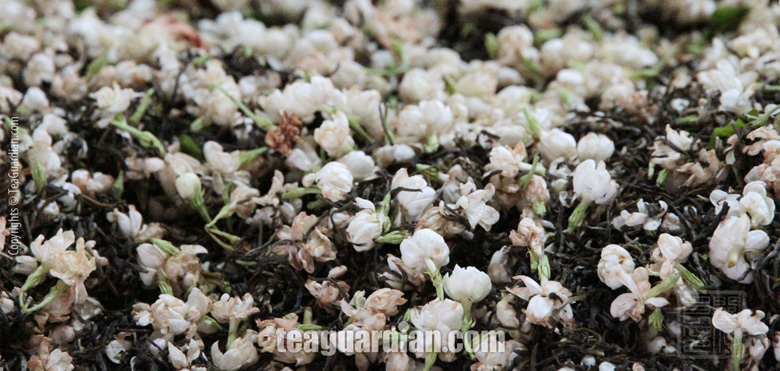
Jasmine flowers used in scenting tea will be sieved out for other use. An ideal jasmine tea does not contain flower bits.
All better quality scented teas have the flowers removed to avoid muddling the taste of the tea. In some cases, a few dried petals are added as decoration. Flowers used in scenting are often reused as the materials for adding in other teas, such as Xiang Pian (often labelled in English as Jasmine Tea) in restaurants or supermarkets.
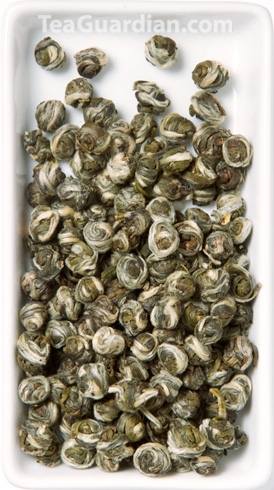
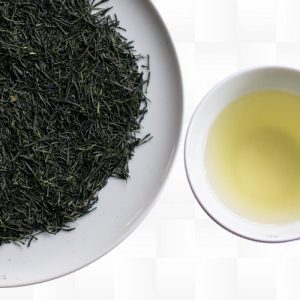
Jasmine Silver Pearls, aka Honey Pearl Pekoe, Moli Xiao Longzhu 茉莉小龍珠, is a premium scented green tea. This one is a premium quality from Fujian
Scented selections
Personally, I am not especially fond of scented teas. However, there are fine jasmine scented greens and exceptionally commendable osmanthus scented Phoenix oolongs around. More popularly available are rose scented blacks, osmanthus scented bead shape oolongs, and jasmine scented greens from various regions of different craft finishes. All these can be different quality grades.
Selecting criteria
An ideal scented tea should have a fragrance that agrees with its taste. Individual preferences can be light and subtle, deep and dense, or high and bright, but nothing should be exempted from the tasting test. Select a scented tea as you would a non-scented one.
For jasmine greens, I’d avoid those that are presented with jasmine petals, not only because infusing the flower would give you an additional taste that is not a good dimension to the taste of the original green tea, but very so often used flower parts are used and they not contributive to the overall purity of quality of your drink, as I have said earlier in this article.
The same idea goes for osmanthus scented oolongs. The more elegant taste of the rose, however, is an exception. The taste of rose in hot water so naturally blends in with most fine black teas so the presence of their petals does not bother me. The real problem is that most rose scented black teas are not naturally scented with the flower nowadays; so I’d urge those of you who like rose tea to double-check how your leaves are scented. Let me know if you find any really natural rose scented selections — they are rare. Label laws for scented teas are still way too lax even in most EU countries.
I have in the tea list a couple of examples for your reference. There may be more as the list grows.