Tea Etiquette: Using the Gaiwan as a Cup
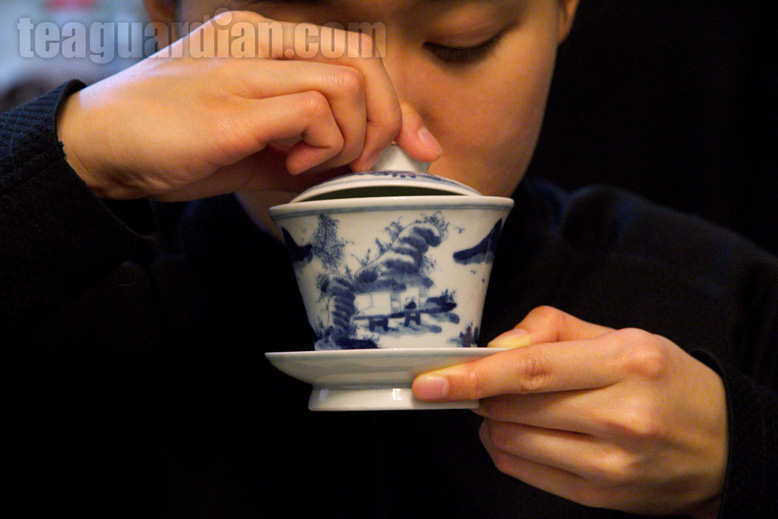
Drinking from the gaiwan
The original form model of the gaiwan was invented as a cup. It is unclear as to the history of its development but we can find traces in paintings and writings of the past. (More in the Pictorial History of Gaiwan)
The saucer with a tea bowl had already been widely used between 7th and 9th century when the popular mode of consumption was adding hot water to the tea bowl with ground tealeaves in it. Some ancient encyclopedia writes that the saucer was devised in the 8th century to hold the bowl without burning the fingers for a court lady who preferred to use gold as the material for her tea bowls (note).
Drinking directly from the Gaiwan
Using the gaiwan as a cup was extremely popular amongst the Manchurians during the Qing Dynasty (1644~1911). They simply sprinkled some tealeaves into the bowl, added hot water, and drank directly from it. The default tea categories of choice were green and jasmine scented green teas. That is one reason the shape of gaiwan that was preferred in those days by these nomads were taller: the stronger and more bitter tea remains closer to the bottom of the bowl and the user always drinks the lighter portion that is on top. Since the Manchurians were the ruling people in those days, their preference made substantial influence on the design of the gaiwan, except for those used by people in the extreme south where the gaiwan has been more popularly used as a teapot rather than a cup: Guangdong and Hong Kong — where the classic bowl shape remains as the default choice.
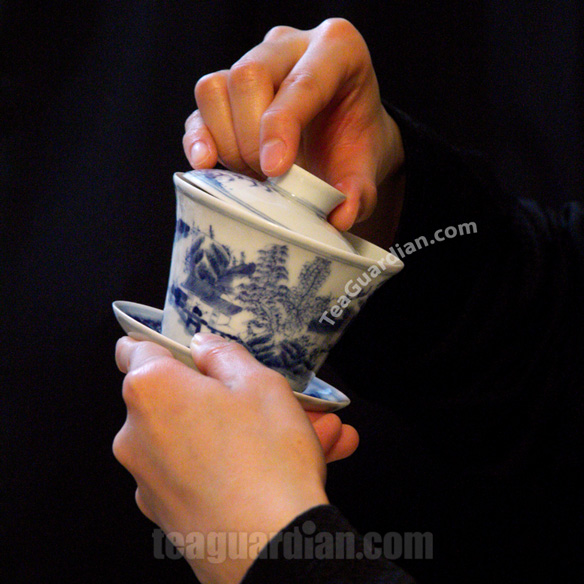
The gaiwan, when used as a cup, is to be held by the saucer in place even when tilting it to drink from it.
The receptacle saucer is the handle
The shape of the saucer is crucial when the gaiwan is to be used as a cup. It has to hold the bowl quite well when tilted. Rather than thinking of it as a saucer in the Western term, it should be understood as a receptacle for the bowl. The original name for it was “holder”, rather than saucer or plates etc.
Holding the lid
When drinking from a gaiwan, always hold the saucer by the rim with one hand and the top of the bowl lid with the other. The lid remains on the bowl even when you sip the tea, tilted only slightly to leave a slit opening for the liquid. This has a few ideas in it:
- To strain tealeaves in case they are presented in the bowl
- To hold the bowl lest it slips from the saucer
- To avoid having to take away the lid to place it anywhere else when the condensation on it could wet other spots
- To minimize heat loss from the tea infusion
-

- Lid: Not only is the lid instrumental for infusion quality and ease of handling, it is also decisive to the look of the gaiwan. The dome has to rise high enough for proper insulation for the surface of the tea liquid, yet low enough for the fingers to manoeuvre on it with comfort. The rim has to be thin enough for precision in scooping the leaves, tea foam etc, and yet not too thin to be easily breakable. The button, which is critical for handling whether using the gaiwan as an infusion tool or as a cup, has to be raised high enough from the lid to avoid too much heat conducted to it. To that ends, thinness of the material is also critical.

-
- Tea Bowl: The shape, thickness distribution and material integrity of the tea bowl is the soul of a gaiwan. The manner with which heat is circulated, dissipated and maintained inside of it is key to infusion quality. Proper thinness and curvature at the brim, a wide enough belly to allow scooping by the lid and a balance of weight are key to smooth handling.

-
- Tuo: The tuo of a gaiwan serves both the purpose of a saucer and that of a cup ear. It has to have a receiving cavity to fit the foot and bottom of the bowl nicely so that when the bowl is tilted for drinking, it is still securely held between this cavity and the lid that is pushed back, held by the other hand. Other names for the tuo include receptacle, saucer, tea bowl stand, etc. For more info about how to use a gaiwan as a cup, please read this article: Using the Gaiwan as a Cup

Lid placement as a communication
When you need a refill but you are not supposed to do it yourself, always leave the lid half open on the bowl so the one who is responsible for refilling your gaiwan can be visually hinted. When you do not need a refill, the bowl of the gaiwan should always be properly lidded.
“Waist” of the tea bowl
Now you see, the bowl is never touched by the drinker other than his/her lips. It’s a hygiene concern in addition to a mannerism one. For the same idea, the preparer for the tea touches only the belly of the bowl when putting the bowl on the saucer. The rim of the bowl, where the drinker puts her lips to, is never touched by the hand. This is different from when the gaiwan is used as a teapot. And this is one more reason the gaiwan for drinking as a cup should not have straight sides, so the “waist” of the belly can be held quite steadily when the bowl is being put on the saucer.
Filling water/tea
Tealeaves and/or hot water and/or tea is added AFTER the bowl is rested on the saucer receptacle. Water/tea is never filled to the top, but a few millimeter below the level where the lid covers the bowl. Again, this is different from when using the gaiwan as a teapot in gongfu infusion. This is so designed simply for tidiness and presentability. Remember it was the ruling class using the gaiwan as the cup back in the imperial days?
When water is being added to the bowl, the lid is open and held vertical over and within the edge of the bowl, the top of the lid facing the drinker and the opening on the other side. It is a gesture such as to refrain accidental splashes come to the drinker and drips can always fall back into the bowl.

This is how the gaiwan is held when offering tea in it to a guest
The most usable vessel after all
Admittedly, the gaiwan when used as a cup will demand a bit of practice for those who have grown up using the “eared” cup and saucer. It is not at all difficult, however. Once when you are used to it, its physical characteristics and the manner that required of you would channel your experience in tea to yet another horizon.