Caffeine: How Much is Safe?

How much caffeine is safe?
What food standards agency have to say
Food Standards Agency of UK recommended in 2001 that the maximum safety caffeine intake for a pregnant woman is 300 mg per day to minimize risks of low birth weight. That accounts for any caffeine intake, including that in the chocolate bar, “energy” drink, cola drink, coffee, tea and any other items with caffeine that one may consume in the day.
As for the “average” person, there have been various theories, most say 600 mg.
I am copying the UK survey (2004 version) of the “mean” caffeine content of each of these popular items:
- Average cup of instant coffee – 75 mg
- Average cup of brewed coffee – 100 mg
- Average cup of tea – 40 mg
- A cup of regular cola drink – 40 mg
- A serving of regular energy drink – 80 mg
- Plain bar of chocolate – up to 50 mg
one cup = 215~234 ml, on average, according to the survey of actual serving sizes in UK
So How Many Cups of Tea a Day?
This computes to 7.5 ‘average’ cups for the pregnant woman and 15 cups for the ‘average’ person. The ‘average’ cup of tea, according to the FSA survey, translates as 1 g of tealeaves to 100 ml of water. That means 16.5 g of tealeaves for the pregnant woman and 33 g for the ‘average’ person. We have toned this down for your safety to 6 cups a day for the pregnant woman in the do’s and don’ts page in this site.
What about alternative drinks?
Most herbs claim to be caffeine free are simply not tea. They may have some other benefits, but they do not have the potency of the benefits of real tea.
Caffeine exists also in yerba maté in the name of mateine, and in gurana as guaranine, but they were omitted in the FSA survey, but listed in other scientific studies. In the past the caffeine in tea was misinterpreted as theine, but now people understand that theine and caffeine has the same properties. Mateine and guaranine are no difference. People who think that they are able to avoid caffeine by choosing alternatives plant based beverages should rather consider decafs (not that I recommend them).
Still much to find out
The odd thing is, all but 3 of the hundreds of tea samples involved in this survey are teabags of supermarket quality, with caffeine content ranging from 1 mg to 90 mg per cup. Fine teas are almost always skipped in surveys as such but used in medical studies. Like I said, much work is still needed for a better database.
During a presentation session in Tea Expo 2000 in Paris, a very interested old lady told me that she switched to tea because she was informed that it would not give her the shaky hand as coffee did. The change was not doing her any effects, she explained, until she started to use better whole leaf tea.
There is also great disagreement as to how much caffeine there is in green tea. Some studies have it as much as 40 mg in the cup, some 15 mg, vs 50 ~ 70 mg in black tea. The fact is, the composition of tea varies with the employed cultivar, harvesting season, horticultural conditions and manner of production; in another word, what is in the final product is really dependent on the quality, not the product’s category.
Oolongs: a possible alternative
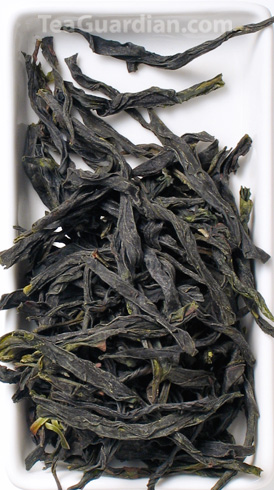
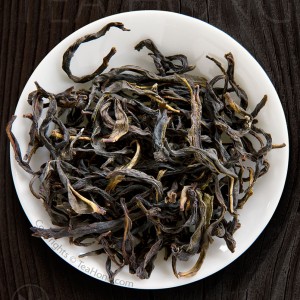
Lanhua Xiang Dancong 蘭花香單欉, bouquet style Phoenix oolong
This is a traditional oolong. Notice the larger leaf size compared to green or black tea, the slight degree of rolling/twisting that results in the much exposed leaf surface of the yet intact leaf structure.
If available databases for caffeine content in green and black tea is less than ideal, that for oolong only leave us in the dark. Most studies employing more contemporarily measurement techniques have shown that oolongs have markedly lower caffeine contents than green or black teas — some as little as one-fourth of green teas. This is contradictory to the myth that the higher degree of fermentation, the more caffeine content.
For example, in a study jointly executed in University of Michigan and University of Massachusetts (7), an oolong from Fujian (purchased from a Chinatown, with no more specific description) can be containing 7.4% (dry weight) caffeine, as compared to 23 to 29.6% in four other green teas. This maybe a result of the lower caffeine contents in the relatively larger leaves that are used in making oolong (8).
Younger leaves and buds, generally with more caffeine proportionally, are typically used to make green and black teas. In that same study, two other teas were involved, an oolong from Jiangxi, measuring 18.7%, and a Fujian black tea, 21.6%, both are still lower than the green teas in caffeine.
traditional wisdom
The way that traditional forms of oolongs is produced and consumed may lead to even less intake of caffeine. Since these oolongs are twisted AFTER fermentation, much of the juice surfaced and thus the caffeine content crystallizes on the surface of the leaves during the baking process. Since the substance is readily soluble, the way that most connoisseurs blanch the tea once before steeping practically washes away a large portion of caffeine.
I have seen on the internet some people advising consumers to steep green or black teas for 20 or 30 seconds before discarding this “first infusion” to avoid as much caffeine. This is a little ridiculous because by that much time, a large portion of other salutary and gastronomical content of tea have also been dissolved in the water. It is difficult to avoid much caffeine in these two categories of teas without sacrificing their other virtues. Traditional oolongs, namely longitudinally twisted ones such as Phoenix and Wuyi, are exceptions because of their production process. Always blanch the tea quickly, in a matter of a few seconds, if you agree with me that managing caffeine intake should not outweigh other reasons for you to enjoy tea.
There is also the misperception that lighter colour teas contain less caffeine than darker colour ones. Colour is not an indicator of caffeine content. The substance is colourless when dissolved. In a study of caffeine content in common beverages in Croatia (9), scientists even concluded that white tea has the most caffeine content in all tea categories. However, their sample lots were suspiciously few and I guess mostly because they have used poorly stored tea and other teas made of grown leaves. Younger leaves that are used to make most white teas, better green and black teas typically have more caffeine.
Natural or decaf?
On the safe side, when you are really concerned about the issue and need to calculate your total daily intake, take each cup made from 3 grams of tealeaves, brewed straight in 5 minutes, as 40 mg of caffeine before scientists are able to come up with a more comprehensive database.
I do not, in any way, recommend decaf products because basically you are left with the choice of either very poor quality or the worst quality. You would be forced to give up the option of the much finer tasting, much more salutary quality, and the larger range of fine teas.
Better ways
If you really want to watch out for the caffeine quantity in your tea, try some of these suggestions instead:
- Use traditional oolongs. Matured oolongs may contain even less caffeine.
- Blanch your tea before steeping; caffeine dissolves quite quickly in hot water and can thus a portion can be washed away in the discarded water. This applies only to tea selections in which most caffeine crystallizes on the surface of the tealeaves, such as traditional oolongs
- Avoid tea after 8 pm, some suggest 3 pm, it is really dependent on the individual
- Make tea with ample strength and drink water afterwards, so you are satisfied with the need for the taste and not consuming excessively, which you may if you are drinking weaker ones
- Minimize intake of OTHER things with caffeine but without the “good-guys” in tea (e.g. polyphenols, theanine, etc), such as cola and energy drinks
- Stay away from any cold drinks, including cold tea. A chilled stomach is a weakened stomach, which in turn weakens your body and your ability to metabolize the absorbed caffeine
- Keep a healthy life style. Good eating, sleeping and exercise habits help to build a healthier body against allergies and intolerances
Next: Caffeine Content in 39 Tea Samples